
Home Energy Rater Training — Our First Year Review
 Energy Vanguard has been a Home Energy Rater Training Provider for one year now. We received our accreditation from RESNET in July 2010, and we just finished up our fourth class. As always right after a class, I’m both exhausted and exhilirated. I love teaching. I love homes. I love building science. I love seeing people get excited about learning new things.
Energy Vanguard has been a Home Energy Rater Training Provider for one year now. We received our accreditation from RESNET in July 2010, and we just finished up our fourth class. As always right after a class, I’m both exhausted and exhilirated. I love teaching. I love homes. I love building science. I love seeing people get excited about learning new things.
And I really love seeing the look on someone’s face when one of their most cherished beliefs about how houses work gets shattered. “What?! You told the builder to put a 4 ton air conditioner in a 7300 square foot house? I’d put 12 to 15 tons in that house.” I especially like blowing the minds of the HVAC guys! (And yes, we really do have a client building a 7300 sf house in Georgia that we did the HVAC design on, and yes, we spec’d a 4 ton mini-split heat pump.)
First Year Review
So, one year into our HERS rater training,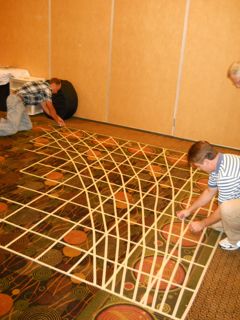 I think it’s time to look back and see how we’ve done. If you recall, I had some big ideas about how our class would be diferent than others and would include a lot more hands-on time and less of the death-by-PowerPoint style of teaching. I also claimed that by offering the test three times within the extended 8-day class, we’d have a better pass rate on the national home energy rater test. Have we succeeded? Keep reading.
Regarding our putting more hands-on time and learning activities into the curriculum, I think we’ve done well. The students get their hands on the home energy rating software (REM/Rate) from the first day of class, and we have them do a lot of different activities with it, from simply building library entries to completing full-blown ratings. We also have them do scavenger hunts through the HERS Standards, play psychrometric chart Simon Says, and discuss ConcepTests with their classmates.
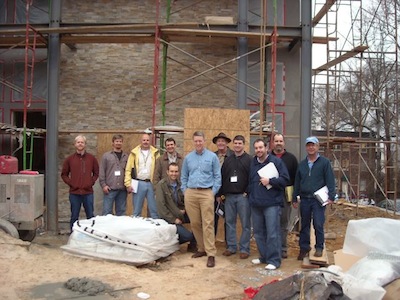
The students go out into the field and get their hands on real houses three times during the week. On the first day, we spend the whole afternoon visiting two homes: a new home under construction and an existing home. We do some pressure testing, so they they’ve all at least seen it done before we explain the theory behind it.
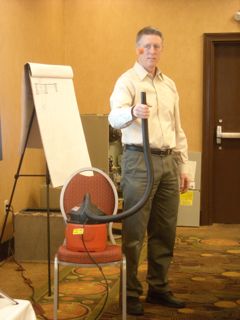 Since I’m a recovering academic who used to teach physics, at both the high school and college levels, I draw on my physics teaching background to supplement the students’ learning. We may be the only HERS rater training provider that demonstrates Bernoulli’s principle to the students when we talk about pressure and ducts.
In addition, I discovered Eric Mazur’s method of using ConcepTests when I taught physics at Haverford College in the late ’90s and use them to break up the presentations. Throughout the presentations, I have slides that ask a question and give answer choices. When the students see the word ‘ConcepTest’ at the top of the slide, they turn to their neighbors and discuss what they think the answer is. An example of a ConcepTest question we use is, Can a house be too tight, or does it need to breathe? This is a great way to break up presentations and get the students minds actively involved with the material.

Even better, I like to get them out of their seats. One of my favorite activities is to have the students construct a psychrometric chart on the floor using masking tape (second photo from top), and then I place them on it, and we play Psychrometric Chart Simon Says. That’s always fun!
As I mentioned, our class is 8 days instead of the more typical 5. We go Monday through Friday the first week, take the weekend off, and then Monday through Wednesday the second week. In the first week, we do a bit of everything, but the main objective is to prepare the students for the national HERS rater test. After the first week, they take the test for the first time. If they don’t pass, they get two more attempts, included with the price of the class.
We’ve had pretty good results doing it this way. In our four classes, 83% of our students have passed the test. Most did it in the first three attempts during the class, but two needed a fourth attempt after the class was done. We follow up and try to get everyone through the test and other requirements. If they commit to passing, we’ll do whatever we can to help them achieve their goal.
The second week of class is mostly  hands-on time with the software and the pressure-testing equipment. The students work on a variety of rating activities, including the two home energy ratings they have to complete to pass the class. They also practice with the Blower Door and duct leakage tester so that they can pass the oral exam. We have each student go through some of the setup and testing procedures, and I ask them questions to see how well they understand it. They get results, interpret them, and show that they know the fundamentals of pressure testing.
Our Grade
Overall, I think I’d give our training a B so far. I think we’re doing a lot of really nice things, but there’s still room for improvement. Our pass rate is really good, I believe. I don’t know what other HERS trainers are achieving there, but based on anecdotal evidence, I think a pass rate of 83% is above average. I also think that our students come out of the class with a better grasp of the building science, how to use REM/Rate, and how to do the pressure testing than students who have it all crammed into 5 days. I also like the activities we do to get the students actively involved in their learning.
Where I think we can improve is in reducing the amount of presentation time even more and incorporating more learning activities. I’m working on some new materials to use in the class that will help me eliminate some of the presentation and also will help them look things up during the test. In addition, I’m working on some pre-class online learning methods that should help students come into the class with a more complete foundation.
So, there you have it. I wrote in this space last year that I’d be open with our results, and now you know how we’ve done. What do you think?
Related articles
Home Energy Rater Training – A New Approach
5 Keys to Success in Education for Green Jobs
Is HERS Rater Training a Scam?
This Post Has 11 Comments
Comments are closed.

Great job!
Great job!
In my experience these classes are usually rushed, leaving half the students reeling in significance.
Your class sounds great.
Consider putting a library of
Consider putting a library of materials & tools on your website for those who complete the class. I understood the concepts after my first class, but going beyond a simple house ate my lunch for awhile–trying to match the house to the software. For example, knowing where to find the user manual would’ve helped.
Christopher
Christopher: Thanks. Yeah, my experience with the 5 day class is that it’s very rushed.
Sam: Yes, we have some of the materials available for our students and raters online, but we’re planning to do a lot more in that area. Good point about the user manual!
Allison, I applaud your
Allison, I applaud your earnest efforts to get better and better, and your commitment to the honorable job of teacher.
Here is my main idea about improving the course – Pre-work: prior to attending the course, require reading of Krigger & Dorsi’s Residential Energy (enforced by simple/brief chapter quizzes that must be completed before HERS class and/or discussed on day 1) and an online geometry primer (with a couple of basic house volume calculations). The former will give the “velcro” framework for new knowledge to stick to; the latter saves some time during class.
Allison,
Allison,
Congratulations on your one year anniversary, and your laudable objective not only to offer instruction, but to insist on a superior level of teaching. Makes me want even more to get down to GA and take your class!
Now, psychometric Simon Says sounds interesting…just glad its not psychometric Twister! That would probably be a bit…awkward! 🙂
~John
Allison,
Allison,
When I decide to get my HERS rater certification, I hope I can pull the resources together to come and take your class. I love the hands on approach much more. Plus the idea that you utilize your physics background definitely turns it up a notch.
Tom:
Tom: Thanks! Those are good ideas and would help a lot. I also need to figure out how to get people to actually take that time out of their busy lives to do the pre-class work. Your idea of having everyone pass quizzes before they come to class is probably the way to handle that.
John: Thanks, John. I’m surprised you didn’t mention wanting partial differential equations in the class. I’m sure we could find a way to indulge you, though, if you can make it down here.
Josh: We’d love to have you! You aren’t the only one in Ohio who wants to come down here for our class.
Allison,
Allison,
You are such a fresh breath for our industry. Your love of education and good building science spills over and we are all jealous. Keep up the great work.
i would prefer the 8 day model but i can’t seem to get folks to miss that much work or pay what i need for that amount of time. Learning building science in college entailed 24 days of 2 hour classes over three months. This also included watching fellow students present varying projects that broadened our understanding. The 5 day fire hydrant water bottle approach is for the birds!
Scott:
Scott: Thanks! The 8 day model is difficult, and I do believe that our numbers have been lower because of it. As you so clearly point out, though, anyone who really wants to understand this stuff has to put in a lot of hours over a long time span. The brain takes time to assimilate all this information.
Allison,
Allison,
Congrats on the anniversary!
After taking your 8 day HERS class and a Fire Hose 3 day BPI class taught by someone else, I can say I prefer your approach. You were able to go deeper and explain each aspect and how it pertains to the house, not just the test.
Being able to actually go into the field to multiple house all in different stages of construction or even older houses allows for the principles to be brought into the real world.
Thank you for your training and all that you do to promote healthy and comfortable house and the industry.
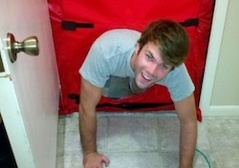
I love the “Hole of Shame” picture in the article. Admit it, we have all had to crawl through it at least once if not multiple times.
Tripp:
Tripp: Thanks for your kind words. I appreciate it! And yes, everyone has to crawl through that hole at least once. It’s a rite of passage for Blower Door testers.