
Does a Geothermal Heat Pump Count as a Renewable Energy Source?

Here’s another rant that goes in my Drives Me Crazy category of articles. I’m in good company, too. Green Building Advisor ran an article this week about making the choice between an air-source heat pump and a ground-source (aka geothermal) heat pump. At the end of the article, Peter Yost mentioned that ground-source heat pumps, “have been given quite the green ‘pass’ or ‘seal of approval’ because they are portrayed as using a ‘renewable’ energy source, and that makes me crazy.”
So there’s your answer to the question I asked in the title: No! Ground-source heat pumps are not a renewable energy source. Let’s all go out and have a productive day now.
Oh, OK, I’ll say a bit more. Remember last year when I wrote about how your air conditioner works? Before that I’d already written about how air-source heat pumps get heat out of cold air to heat your home in winter. A ground-source heat pump does exactly the same thing, with one difference. In an air-source heat pump or air conditioner, you’re pulling heat from the outside air and putting it into the home (heating mode) or putting heat from the home into the outside air (cooling mode).
The diagram below shows what’s going on. The heat exchange with the outside is going on in the part labeled as the condenser coil. In an air-source heat pump, that coil surrounds the noisy metal box that sits outside your home. The fan inside the condensing unit pulls outdoor air across that coil, and the refrigerant running through the coil either gives up heat to the outside (cooling mode) or picks up heat from the outside (heating mode).
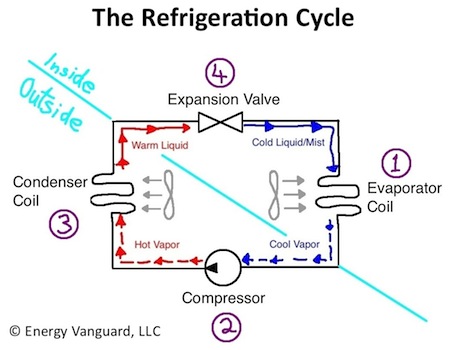
The only substantial difference with a ground-source heat pump is that you’re using the ground (or a body of water) instead of the outside air. The heat exchanger in a ground-source heat pump isn’t a coil but a loop of pipe carrying the working fluid. That loop of pipe can be horizontal or vertical (see photo of well above), but its job is simply to exchange heat with the ground. It’s doing exactly the same thing as the condenser coil above.
I think the source of the confusion about ground-source heat pumps and renewable energy is the unfortunate use of the term ‘geothermal’ in connection with these devices. When you hear the word ‘geothermal,’ you think of lava or geysers, of volcanoes blowing their tops. You think of beautiful Icelandic maidens in steaming pools of hot water surrounded by snow. (Or is that just me?) You think of heat engines being driven and doing useful work by harnessing the heat from within the Earth.
But that’s not what ground-source heat pumps are or do. They’re just like your regular air conditioner or heat pump except they use the ground instead of the air as the source or sink for heat. They still use electricity to power the pump that moves the working fluid through the loops. They still use electricity for the blower that moves the air through the duct system. They still use even more electricity to run the compressor, which is the pump for the refrigeration cycle. That electricity generally comes from outside the home, often from a power plant that burns coal or natural gas. Last I heard, most folks don’t consider those fuels renewable.
I don’t use the term ‘geothermal heat pump.’ It’s too confusing. Even Thomas Friedman, the columnist for the New York Times who’s written some well-received books about the environment, is confused about this. He wrote in a column a few years ago that he’s using renewable energy in his home because he installed a geothermal heat pump.
Really now. If a ground source heat pump is a renewable energy source, then so is a refrigerator. Can you see why this drives me crazy?
Allison A. Bailes III, PhD is a speaker, writer, building science consultant, and the founder of Energy Vanguard in Decatur, Georgia. He has a doctorate in physics and writes the Energy Vanguard Blog. He also has a book on building science coming out in the fall of 2022. You can follow him on Twitter at @EnergyVanguard.
Related Articles
How the Heck Does a Heat Pump Get Heat from Cold?!
The Magic of Cold, Part 1 – How Your Air Conditioner Works
What IS Heat Anyway? – Building Science Fundamentals
Photo of woman in hot spring by Andrea Pokrzywinski from flickr.com, used under a Creative Commons license.
This Post Has 37 Comments
Comments are closed.
Enjoyed your post, as always!
Enjoyed your post, as always! I look at them (whatever we want to call those systems) as an energy efficiency resource. Or maybe one of several possible high performing HVAC systems. We’re consistently able to get earth-coupled heat pumps to operate more efficiently than other systems, but calling it a renewable energy resource is, technically, wrong.
Ah but all heat pumps are
Ah but all heat pumps are using renewable energy because you are simply transferring heat from one location to another.
How timely….we are meeting
How timely….we are meeting with a homeowner today who is faced with the dilemma being debated over at GBA on just this issue. We are presenting a Mitsubishi 3 Zone system vs. Geothermal. Our price for the HVAC, an ERV, Crawl-space Encapsulation and complete shell of Certainteed Spray-Foam is less than the initial cost of the Geothermal Heat Pump system.
This particular project is on a lot that is less than 4,500 sq. ft in total with many very mature trees. The load on the house (if spray-foamed), is less than 2.5 tons in total. Hard to meet that demand accurately with the Geo system
One thing we talk about often is that with Inverter driven technology, the Mitsubishi system is more of an “on-demand” technology. Meaning it can scale up and down across a wide range to keep the home at the desired level of comfort, all the time. Also, the level of humidity control is phenomenal, adding to more comfort.
We put Mitsubishi in our office space and I have never worked in a more comfortable environment. Our bills right now are averaging around $115 a month for 1,300 sq ft of office and 2,700 sq ft of warehouse space (not conditioned), a bulk of that is warehouse lighting.
Will be interesting to see what the homeowner decides.
Ah, but it is renewable
Ah, but it is renewable because many legislatures have classified it as such 😉 It’s a stretch, but some people say it is renewable because you are storing the sun’s energy in the ground over the summer to use as heat in the winter. I do recall that there were some studies that explored the sun heating effect and found it to be minimal.
Just to be a pain in the butt, the energy you input into the system is only used to move heat around. From your house to the ground in the summer and from the ground to the house in the winter. So, you could say the heat is renewable, but the energy to move that heat around may or may not be.
Ah, yes Gordon, but that
Ah, yes Gordon, but that transfer of heat from one place to another requires electrical energy, which most likely does not come from renewable resources.
On today’s NPR Morning
On today’s NPR Morning Edition, I heard about the city of Brainerd, Minn., using something a bit less conventional as a heat sink: the sewer.
A sewer — the place where a city’s hot showers, dishwashing water and organic matter end up — is warm enough to generate energy — meaning a city’s sewer system can hold tremendous potential for heating and cooling. The police dept and local high school will be the first to utilize this system.
Hey, this is pretty interesting stuff. Extracting it economically is the critical second part.
Now THIS is a renewable energy source.
I’m with Lance on this. The
I’m with Lance on this. The efficiency and simplicity of an inverter driven split system like Mitsubishi’s outstrips any gains from a ground source geothermal system. Ground source geo is complicated and expensive to install. The efficiency gains do not include any sort of pumping you need to add. With inverters, the minisplit’s efficiencies are close to that of geo anyway.
Dan K.:
Dan K.: Thanks!
Gordon K.: I revised the end of the article a bit to clarify why exactly they’re not a renewable energy source. They still use electricity that’s usually generated in a coal-burning or natural gas-fired power plant (depending on where you live, of course). The transfer of heat between inside and outside takes energy.
Lance: Good point. With moderately sized homes and good building envelopes, ground-source heat pumps are often overkill.
Louis: By the same logic, an air-source heat pump is a renewable energy source, too.
John R.: Yep. I added that to the article above.
James G.:
James G.: I’ll have to check into that one. I’m not sure that would qualify as a renewable energy source, though. It’s more akin to the drain-water heat recovery systems that some people install in their homes. If they’re actually using the heat in the wastewater to generate power, it’d be more like landfill gas generation plants.
technically, you’re wrong.
technically, you’re wrong. the actual heat energy is in fact renewable. Even if you pulled heat out of a volcano like real geothermal heating would, you still have pumps and energy requirements to distribute that heat.
Your quibble here should not be that there ARE heat distribution requirements, but that those requirements are high enough to be a significant detriment on the greeness of the renewable energy being used.
So the correct argument is “how GREEN is this, really” not “is this renewable”. it is renewable energy. it is significantly less green in some parts of the country because of the distribution energy usage.
it’s also important to note that how green this is depends heavily on where you are. In the pacific northwest most of your energy may be hydro. Here in maine we have a great renewable mix in our power. in the midatlantic states you might be mostly coal on that distribution energy.
Finally, it is also important to note that heat pumps are necessary step in the end game of reducing energy usage. It happens to be energy usage in a form we CAN make renewable… electricity. this is not true of any combustion source other than wood/pellets.
regardless, I agree with other posters that air source heat pumps are big winners.
Robert B.:
Robert B.: GSHPs have pumps and blowers that use electricity. That electricity comes, most of the time, from power plants, which usually burn coal or natural gas (depending on where you live, of course). Yes, you could certainly throw some photovoltaics on the roof and use that to power the GSHP, but the GSHP itself doesn’t become a renewable energy source if you do so.
Geothermal energy usually refers to power plants that tap into the heat of the Earth to generate electricity, as described in this Wikipedia article. GSHPs do not generate electricity. They consume it. Thus, they are NOT a renewable energy source. If using the ground as a heat source or sink qualifies it as a renewable energy source, then an air-source heat pump is, too, but moving the heat isn’t what you should be looking at to determine if it’s a renewable energy source or not.
You do raise an interesting issue about how green various types of heating and cooling equipment might be, but that’s for another article!
Nice! Leave it to you, Dr.
Nice! Leave it to you, Dr. Allison, to split hairs in a funny way! Wording is extremely important, and I had never considered the ramifications of the term. Thanks for making me laugh and teaching me at the same time.
Nate A.:
Nate A.: You’re welcome. Glad you liked it. It may seem like splitting hairs but when green building programs award points based on a misunderstanding, it’s a little more serious.
I understand your argument…
I understand your argument… but you’re wrong. The actual thermal energy being “used” IS renewable… it’s being drawn from the ground, or air.
the DISTRIBUTION of that energy just happens to consume a lot more energy than a normal “pump it from here to there” energy system would use. Pumps and blowers do not create energy. they just move it… distribution. By your argument there is no such thing as any renewable system that has any parasitic/distribution energy usage at all. that’s obviously not helpful and not precise.
It doesn’t have to generate electricity to be renewable. Iceland’s district heating is geothermal heat and is renewable, even though you can bet they use some damn big pumps to move it around the city. Solar thermal is renewable even though it has pumps that use grid electricity to distribute that heat. the Thermal energy is renewable.
the “parasitic” or “distribution” energy loss should CERTAINLY be included in any analysis of impact though, if you’re trying to save the planet. and when that is included, you see that is a much bigger factor in geo-exchange heat pumps. But that doesn’t mean it’s not RENEWABLE.. it is using renewable thermal energy. that simply isn’t the end of the analysis.
Robert B.:
Robert B.: Ah, I love a good challenge! Let’s see if I can convince you.
I think I see your confusion because of what they do in Iceland, but there are important differences between directly using heat pumped out of the ground to heat buildings and running a ground-source heat pump:
1. They’re pumping heat from a reservoir at a much higher temperature and using it directly, not running low-temperature heat through a refrigeration cycle as shown above.
2. They can pump heat continuously from their reservoirs, year-round, with no degradation of the resource.
3. If you try to run a GSHP in only one direction, year-round, it will quickly exhaust the resource. Just ask Dan Kerr, the engineer who commented first on this article. He has experience with that problem. That means it’s not renewable, even in the limited sense of that term that you’re using it.
In the more usual definition of a renewable energy source, you could count photovoltaic modules, wind, biomass, or geothermal power (as I mentioned before), but GSHPs are no more a renewable energy source than an air-source heat pump or your refrigerator.
Are you buying it yet?
Hi Allison,
Hi Allison,
Yes, this sort of sh*t makes me crazy, too: When people confuse superficial similarities between descriptive words, and reach erroneous conclusions as a result.
And what really makes me crazy are those who persist in their folly and appear satisfied and even comfortable with it, even when they begin to realize they’d been mistaken.
~John
you’re correct that it’s the
you’re correct that it’s the same for any heat pump, not just geo.
re 1: the only vector for disagreement here is the compressor. the compressor is only moving heat, however. It’s not consuming anything to release energy directly. It’s a fancy pump… a heat pump, maybe ;).
again, the presence of a pump doesn’t render a renewable energy system null and void. we are only talking about the amount of distribution energy needed to utilize a renewable source. In iceland’s district heat the ratio of extracted energy to distribution energy is very large, so you’re apparently comfortable calling it renewable.
in geo exchange, the ratio is not as small, it’s 35% to 50% of the heat gain. that’s important. It’s misleading to ignore it. AND STILL, the thermal energy in play is renewable
re 2/3. just because you can deplete it doesn’t mean it’s not renewable. You can’t collect infinite solar, hydro, or biomass either, you’re limited by the energy flows in those media. not sure why that even entered your argument. The ground will recharge, as long as you are not extracting energy faster that it can replenish.
You are using less energy than you are getting with heat pumps. The difference in those energy flows is coming from somewhere, it’s not magic. the source it’s coming from is a renewable reservoir of energy, energy in the air or the ground. it is factually incorrect to say it is not and, IMHO, just confuses the more important discussion.
Our federal clients find
Our federal clients find Ground Source Heat Pumps on their list of renewable energy sources, so it becomes a preferable solution for them. A VRF/VRV system while perhaps as efficient (although I have yet to see any published information other than “it’s really efficient”) is quite a bit more costly than a conventional solution, plus in zone 7 we need an additional heating system. My GSHP consultants say, why wouldn’t you use the most efficient method of leveraging whatever source energy you are using that you can? (After properly designing a low energy intensity project).
Bottom line is that a number of client find capital dollars easier to get than operating dollars. GSHPs can help in that effort.
Just a note on the wastewater as a input to a heat pump system…. we worked with the Twin Cites South Washington County WWTP in 2000 for just such a system for their office complex. Since the building isn’t metered separately we really don’t know how well it works as far as energy consumption. Effort through the years to install verification metering have not been successful.
One more data point I can add
One more data point I can add to this discussion: over the last few years we’ve designed GSHP systems for several schools in the Chicago area. In consulting with a GSHP designer, we found that over a 20 year period, the ground temperature (the “renewable resource” here) would slowly decrease. The reason being that the schools would reject less heat in the summer than it would need in the wintertime.
absolutely. you can draw
absolutely. you can draw heat out of the ground faster than it will recharge. this is one of the many reasons I favor air source heat pumping over ground source in most, but not all, cases. But it doesn’t change whether or not energy drawn from the ground is “renewable”. Of course it is. at a certain rate.
Another thought-provoking
Another thought-provoking article, Allison. I agree with Bob. There’s really no distinction between the “renewable” credentials of air-source vs. ground source. Ditto for straight AC, or any refrigeration system for that matter. From an sustainability perspective, the only distinction is one of efficiency. And as Lance points out, that distinction is being challenged by technological innovations.
So I do have a problem with the special treatment Congress has given GSPH’s. In my opinion, Congress was hood-winked by industry lobbyists into giving GSHP’s the same treatment as PV, solar water heaters, fuel cells and wind. Many state and electric utilities have subsequently jumped on the bandwagon. If the goal was to encourage energy conservation and efficiency, so much more could have been done with less money.
It may not be renewable
It may not be renewable energy but I love my ground source heat pump. It beats the air source hands down, summer and winter in the southeast. Had three window units with a gas boiler and radiators in our 1923 home. Never consistently cool or warm at times. Now I am conditioning the WHOLE house at approximately the same price year around. It would have been prohibitive without the tax incentives which paid for the major cost, three point wells. Do not miss the noisy condensing units and the house will never need one unless there is an earthquake.
Thanks for the Mitsubishi information. Nice to have an option if the tax incentives disappear.
John P.:
John P.: Well, I’m not the only one then. And what do you think about Icelandic maidens in steaming pools of hot water?
Rob B.: I can see I’m not going to succeed in convincing you on this, so we’ll just have to agree to disagree. But I will say that we disagree on the role of the compressor, too, because that’s the major consumer of energy in the refrigeration cycle. I should have included it when I mentioned the energy use of blowers and pumps because that’s a big one.
David W.: Good points, all. I’m not saying that GSHPs can’t be a good choice and save energy. My main point here is whether they’re a renewable energy source or not.
Louis VB: Yep, and as the ground temperature decreases, the heating efficiency drops.
David B.: I thought I might see you jumping in on this one. I didn’t specifically mention Congress’s designation of GSHPs as renewable for tax credit purposes, but that’s the real root of this discussion. And you’re absolutely correct, of course, that “so much more could have been done with less money.”
Blake T.: Yes, there are definitely advantages to GSHPs. They’re often oversold, though, but that’s another discussion. You could have gotten similar result with mini-splits, and even though they have condensing units outside, they’re almost inaudible unless you get right up close to them.
Actually, the IRC section
Actually, the IRC section (25D) that authorizes tax credits for PV, solar water, fuel cells, wind and ‘geothermal’ heat pumps is entitled “Residential energy efficient property.” The word renewable isn’t mentioned. Go figure.
But by association the implication is clear, and manufacturers have exploited this perception. Unfortunately, the home performance industry has fallen for it — hook, line and sinker. The irony is that the more efficient we make the envelope, the harder it is to justify these higher efficiency heating and cooling systems. If we care about the environment, we should also try to maximize energys savings within budgetary constraints. That means choosing the most productive efficiency measures.
As Blake points out, without incentives, ground source heat pumps are not cost-competitive. In fact even with the tax credit, I rarely find the economic rationale for a GSHP in my residential new construction projects. Most of the homes I work on are just too darned efficient!
As an aside, most folks apparently don’t realize that the “geothermal” heat pump tax credit only applies to the heat pump itself, and the ground loop system. Distribution components (ducts, radiant floors, zone controllers, etc) and HRV/ERV systems are not eligible, even though most dealers hand out tax credit illustrations based on the entire contract price. I’m not an attorney, but if a dealer provides an illustration they know is incorrect, I don’t think the standard “consult your tax professional” caveat provides much cover. It’s only a matter of time before the IRS catches on.
The vision of the maidens is
The vision of the maidens is much more refreshing than my previous vision of a bunch of really old, fat, Swedish guys wrapped in bath towels and sitting around a frozen old hut, pouring water on a bunch of hot rocks in the center and breathing in all the resulting steam. Then running outside and jumping into a big hole cut out of the ice. Seriously.
“Congress’s designation
“Congress’s designation of GSHPs as renewable for tax credit purposes, but that’s the real root of this
discussion.”, ” without incentives, ground source heat pumps are not cost-competitive.
Hold on here,
Is this not just one group of welfare recipients, criticizing another? The Pot calling the kettle black?
Gotta love it
PJ wrote:
PJ wrote:
> Is this not just one group of welfare recipients, criticizing another? The Pot calling the kettle black?
How so?
Conor, please do not post
Conor, please do not post private correspondence regarding a project in this blog! I have asked Allison to remove.
This is so simple, and the
This is so simple, and the fact that Allison likes to go round and round the cup deciding if it needs a metaphor and asking others what they think, only proves how useless he is as an energy consultant.
The GHX is renewable, because given the correct variables, when the building is in the cooling season or rejecting heat, this heat is being stored in the ground. This heat build up can then be used to heat the building in the summer, or rather -the EWTs will be hotter. This provides better EERs and COPs.
You can’t store heat in your kitchen or in the outdoor air in order to reuse it in the same mechanical system.
Everything things else consumes energy without storing it anywhere else. The Blower, the Compressor, and the Water Pump to the loop. They are not “renewable”. Not even metaphorically.
Simple. It did not take me sitting around in college pleasing professors for years in order to figure this out.
Again, the correct conditions need to be looked at, and the building and GHX have to be properly engineered. You don’t just drill a loop before you do whatever you can to the building in order to decrease and balance the loads. So yes, energy raters and HVAC people are just as important, or more important, during the design build phase.
Again I ask the people who consider themselves professionals to have intelligent, informing and unbiased discussions. I would much appreciate if they would stop asking us to stare at a cup until our father smacks us. So far, all I have seen from either side is cheerleaders for the amount of water. No actual facts or comparisons. Amazing what a near century of comfort will get you.
Furthermore, who cares what all these agencies do. Are you for some reason scared that they will misdiagnose an HRV or ERV and a good paying client will somehow not get a measly tax credit? I don’t get it. Do you think that these bureaucracies are any smarter or more organized than you?
Please! someone make me aware of a detailed and unbiased comparison or combination of technologies that includes but is not limited to;
Complete energy usage for a Design year by all devices
At full load, part load, or variable load/speed
What are the EERs for a design year and why?
The cost to install these devices and also the cost to make any other improvements on a building
The prediction for 20 years worth of maintenance including replacement of any equipment
Cost for engineering design
Cost for supervision during installation
When assuming indoor usage and schedules, please include sensitivity assumptions.
Information in 8760 hrs or in Bin/block load form would be best. Also, it would be preferable if you could delineate the waste heat per year of any device as we “might” be able to “reuse” that. I doubt that this is in anyones comfort zone, but you can wish.
The GHX is renewable everything else is not. As for government agencies -get to work instead of bickering over things you most likely can’t change. Something I see from a lot of professionals who have spent too long studying, talking, and in smoke filled rooms with “friends” and not enough doing.
Conor Rickard
Conor Rickard (under pseudonym of Big Khan): If you believe GSHPs are a renewable source of energy, that’s fine. If you believe I’m a useless energy consultant, that’s fine. But I take exception when you say:
It did not take me sitting around in college pleasing professors for years in order to figure this out.
You give my readers the false impression that it was only a few years when in fact it was more than a decade. That’s right, I sat around pleasing professors for 11 years! Oh, how I enjoyed that decade plus, going round and round the cup, thinking up metaphors in those smoke-filled rooms with my “friends,” avoiding any kind of real doing because you know how professors dislike that. So please get that straight.
The point of the article, by the way, was educational. And I learned something, so it served its purpose. This is just a blog and it’s written by someone you consider an overeducated, useless energy consultant anyway, so why are you getting all bent out of shape?
By the way, I deleted your previous comment, and would have done so even if David had not asked, because it was inappropriate. I probably should delete this one, too, because you’re bordering on impolite, but sometimes the delete button just leaves too much fun on the table.
Thanks for not deleting the
Thanks for not deleting the second time Allison. Sorry that you felt the need to delete my previous thoughts. I find it very wrong of you and unintelligent. What’s done is done, and I am thankful that you are keeping this one up.
In my second paragraph I meant to say that entering water temperatures will be hotter in the Winter -not Summer. Sorry. (most all size jobs need a thermal conductivity test. If it is done by the design build team; it will cost less.)
I am still waiting patiently for an intelligent and unbiased analysis of all possible variables. It doesn’t seem like you guys are going begin to provide that. I will keep working at average speed on my end. Thank you for whatever facts you were trying to discuss. My respect will only be gained when I am supplied with information reflecting the caliber of ASHRAE articles, some of which need to be updated.
And no I do not think that an esoteric discussion about bureaucracies is beneficial to anyone. In fact it is harmful to the conscience of many. But I do not feel the need to silence you, only point you in a direction which reflects the most reality.
Alison,
Alison,
I mentioned that you might not be worth your title as an energy consultant. This was offensive of me to say. This is an opinion that has no backing. I do not know you nor have I experienced working with you. It was very rude of me to speak of you in this way.
I am sorry if I offended you.
It most likely lessened the extent to which people gave my statements credence.
I was taken aback at the non plus information concerning ground source being given in the online forums. What I wanted was facts and not opinions or arguments for and against ground source without any kind of scientific study.
I also have a problem with the way things are rated, and overlooked, and sometimes flat out lied about by our government and the agencies frequently funded by it. I think that a lot of ground source people over-talk the technology so they can sell it to someone, but they have no real technical understanding of what goes into design, installation and maintenance. So, I suppose the topic hit a little close to home for me.
Mainly I want to learn from you, not listen to opinions concerning what other’s name things.
I suppose a real world diagnosis of ground source in the southwest will have to be done by me. I should use hard detailed and documented actions instead of shooting my mouth off online or in writing.
If I stepped on your toes in any way, I apologize. You did not deserve it. For any offense to you personally, I am sorry.
I can promise that I will be taking an indefinite vacation from blogs, or getting into an argument with anyone by way of writing, or calling anyone names. I do not wish for this to happen again.
I hope that we can somehow work together and figure out what is best for clients.
I do believe that GSHP’s
I do believe that GSHP’s provide one of the most rational renewable energy sources, because if you design them in a balanced condition, +BTU Summer = -Btu Winter, you do create a renewable system. It’s a Btu rechargeable battery.
I really just want to know which system GSHP’s or the ASHP systems touted in these aarticles has the lowest carbon footprint? Because, in the long run this will be what really matters.
It’s true that with air source systems we are using the air in much the same way as GSHP’s use the ground. The results are not exactly the same though. The air of course confronts us with the same conditions the writers described as causing overheating of the ground. Only it’s already universally overheated. We may not want to acknowledge this. However, with global warming creating a 100 degree month out of our most recent July here in Virginia, are we blowing additional heat into an already overheated and overheating atmosphere? Is it time to raise the outside air design temperature to 100 degrees? When do I use 110 degrees? This is my personal opinion, but blowing heat into a too hot atmosphere is similar to thinking we an just continue to blow CO2 into the air and it is not our problem anymore.
How many heat pumps exhausting hot air into a region add how much to the heat island effect?
Isn’t it smarter to work with the ground at 60 degrees or so? Where is the discussion of water to water GSHP’s which are even more energy efficient?
Water is 30 times more efficient at absorbing heat than air. How many times is water to water heat pumping more efficient than air to air?
…..One day we’ll have great answers. I am not satisfied yet! On the whole I just can’t see that a GSHP with a EER of 40 can be beat. (This fall Climate Master, Water Furnace) If coupled with a VRF how efficient can we get? Can we get to net zero carbon?
GG wrote:
GG wrote:
> I really just want to know which system GSHP’s or the ASHP systems touted in these aarticles has the lowest carbon footprint?
Then shouldn’t the question be based on the total house as a system, not an isolated subsystem? In particular, we should ask how do we achieve the lowest carbon footprint within a given budget? Alternatively, we can ask, which combination of products and building techniques will yield net zero energy at the lowest lifecycle cost?
If the difference in cost between one system and another can be used for other improvements that would provide a greater reduction in energy and carbon, then why would we not do that? Those who advocate a particular technology as a means to achieving high performance are missing the forest for the trees. As in most things, the answer depends on the specifics of the project.
Actually, shouldn’t most, if
Actually, shouldn’t most, if not all GSHP’s be called water source HP’s? They do run into trouble when the ground dries up, don’t they?
This is a great post since
This is a great post since many people overlook the fact that ground source heat pumps do need a bit of electricity to run. If someone really wants to be truly renewable they need to generate that electricity from an alternative source, which some people actually do. Solar and wind are more “pure” renewables.
Indeed a very nice post. I am
Indeed a very nice post. I am also associated with Heat Pump , Air Source Heat Pump , Domestic Heat Pump . Thanks for writing such good posts and as I have subscribed to your blog, I do expect that you will be posting nice posts like this on a regular basis.