
HVAC Secret: An Air Conditioner Loophole the Size of the Ozone Hole
Have you heard the term ‘dry-ship R-22 unit’ yet? No? Well, let me tell you a dirty little secret of the EPA and the HVAC industry. It involves the environment, the costs that homeowners pay to buy and maintain air conditioners and heat pumps, and a legal loophole that’s starting to look as big as the ozone hole.
Have you heard the term ‘dry-ship R-22 unit’ yet? No? Well, let me tell you a dirty little secret of the EPA and the HVAC industry. It involves the environment, the costs that homeowners pay to buy and maintain air conditioners and heat pumps, and a legal loophole that’s starting to look as big as the ozone hole.
Can air conditioning make you go blind?
As I’ve mentioned here before, my connection to the world of heating and air conditioning contractors goes way back. My grandfather had a heating, AC, plumbing, and electrical business (Bailes Electric) in Leesville, Louisiana, and I used to spend my teenage summers going out on calls with him and my uncle all day long. (The measuring cup below, which sits on my desk, is from the earlier business he had with his brother, Russell.)
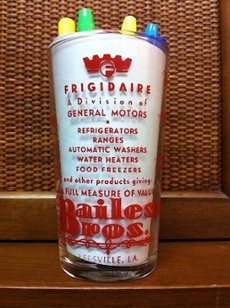 One of the things we often did on calls was put the gauges on air conditioners to check the refrigerant charge. Often, my grandfather, Pappaw, or my uncle would prepare to fix a leak in the system by emptying all the refrigerant first. Back in the ’70s, there were no refrigerant capture systems or regulations, so we sprayed it all right out into the air. The refrigerants of choice at the time were the chlorofluorocarbons (CFCs), which usually went by their trade name, Freon.
Remember that? I did a science fair project on CFCs and their effect on our atmosphere in 1978. Turns out, the stuff migrated up to the stratosphere, where it has a tremendous appetite for the three-atom form of oxygen, called ozone. That wasn’t so good because ozone in the stratosphere has a tremendous appetite for ultraviolet (UV) rays from the Sun. UV rays, you’re probably aware, have a tremendous appetite for skin cells, causing cancer when we get too much of it. You also may have heard reports of sheep going blind in Chile because of the extra UV, but it turned out to be a local infection instead. Still, CFCs destroy ozone and that leads to problems. The science is solid.
Well, in 1987, the Montreal Protocol began the phaseout of CFCs and a plan to move to better and better refrigerants. (Better in terms of their effect on the ozone layer, that is.) In the early ’90s, CFCs were phased out and replaced with the HCFC R-22 in air conditioning systems. At the end of 2009, the US banned the production of new air conditioners and heat pumps that used R-22, and the more benign HFC R-410A was set to become the only game in town.
A loophole the size of the ozone hole
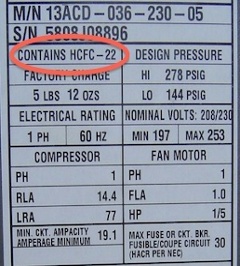 So, the US EPA gave manufacturers and contractors some wiggle room, of course. They couldn’t tell the manufacturers they had to destroy all their unsold units in 2010. They also couldn’t just strand all the people out there who already had R-22 in their air conditioners. As a result, manufacturers could sell their stock of R-22 units, continue to make parts to maintain the existing systems, and keep making R-22 refrigerant.
If you go to the EPA’s website to read about the phase out of R-22, you’ll find this statement:
[H]eating, ventilation and air-conditioning (HVAC) system manufacturers may not produce new air conditioners and heat pumps containing R-22.
Do you see the loophole? As long as they ship the units ‘dry,’ manufacturers concluded, they could continue to make and sell air conditioners and heat pumps designed to use R-22. Hence the term, ‘dry-ship R-22 unit.’
Yeah, but how many are really doing it?
As it turns out, a surprisingly high percentage of new systems are in the ‘dry-ship R-22’ category. Recently I was speaking with an HVAC supply house executive who told me that these loophole escapees make up about 30% of the units they sell. The author of an article on dry ship R-22 units on the Contracting Business website interviewed his local suppliers and found the following:
One supplier told me it was about even. Several more said they sell slightly more dry units than R-410a systems. One supplier told me they sell four to five times as many dry units as complete systems.
Yes, some of these might actually be used as they’re intended — as replacement components in existing systems — but I think most people in the industry know that the majority of these dry-ship R-22 units are new installs.
Who’s to blame?
From what I hear, it was a manufacturer of low-end equipment that first walked through the loophole and starting making dry-ship R-22 units. When the EPA didn’t step in to close the loophole, the race was on. Both the EPA and the HVAC industry share the blame.
The makers of higher-end equipment don’t want to give up market share to those on the lower end who can exploit a bigger price difference. The dealers and the contractors, likewise, have to compete, and the EPA has forced their hand by allowing this situation to continue.
Both sides are to blame: the HVAC industry for exploiting the loophole and the EPA for not closing it. The EPA is definitely more to blame because they could have shut this down as soon as it became apparent. They still can but are dragging their feet.
Carrier has petitioned the EPA to close the loophole. John Mandyke of Carrier, in an interview with ContractingBusiness.com, explained it this way: “As an industry, we were prepared for the R-22 transition — manufacturers had invested in the new technology and contractors had invested in technician training, as well as in helping consumers prepare for this transition. The loophole threw all that up in the air.”
I don’t understand all the forces at work in the meeting rooms of those HVAC manufacturers, but I wish they’d all take a principled stand and refuse to play this game. Perhaps if the bigger names did so, they could shame any company that exploited the loophole.
As long as the manufacturers keep making the dry-ship R-22 units, though, the downstream companies—the dealers and the contractors—feel the pressure to play the game, too. Not all of them, however. I know of one contracting company that, out of the more than 2000 condensers they’ve installed since this came up, only about 10 have been dry-ship R-22 units.
Why you should ask for R-410A
If you’re in the market for a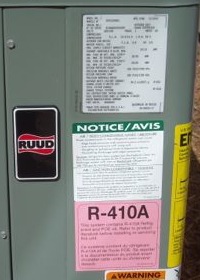 new air conditioner or heat pump, you absolutely need to make sure that you don’t get a new system using what should be an illegal refrigerant for new systems. If the contractor tells you that the R-410A system will be more expensive, ask him or her how much it’ll cost you to maintain the system. If they tell you anything other than that it’ll get very expensive as we get closer and closer to the ban of R-22, steer clear of them.
Here’s the deal:
- R-22 destroys more ozone than R-410A.
- R-22 will get more and more expensive.
- R-22 production ends in 2020, so you may end up having to by a new air conditioner sooner than if you got the R-410A system.
Don’t fall for this! It’s a dirty little secret in the EPA and the HVAC industry with plenty of folks in the industry and government willing to justify jumping through the loophole. Don’t follow them through that hole; the footing isn’t all that steady on the other side.
Further Reading
Dry-Ship R-22 Units: Let’s Stop Shooting Ourselves in the Foot (ContractingBusiness.com)
What You Should Know about Refrigerants (US EPA)
Frequently Asked Questions About The Ozone Hole (wunderground.com)
Carrier Petitions EPA To Close R-22 Loophole (ContractingBusiness.com)
2010 Scientific Assessment of Ozone Depletion (National Oceanic & Atmospheric Administration)
This Post Has 22 Comments
Comments are closed.
You are awesome!! Bravo! I
You are awesome!! Bravo! I bet you sleep well.
Very well said, Allison.
Very well said, Allison. This is shocking every which way: showing wilful disrespect by government and the AC industry to both citizens, who are viewed as mere consumers, and our planet which as ever is just a garbage can.
What’s sad is R410a
What’s sad is R410a condensers aren’t that expensive. Most come with scroll compressors which do cost more than the old reciprocating compressors typically found in R-22 systems. Most R410 indoor coils have TXV pre-installed, unless you buy the lowest cost 13 SEER units. R22 “repair parts” are getting harder to find in efficiencies over 13 SEER, when you do find them the cost is about the same as a R410 unit.
I’m in the middle of replacing my own system, the old system had a freon leak in the a-coil. I also took the opportunity to downsize from a 3 ton to a 2 ton. The 2 ton R410a 14.5 SEER condenser costs about the same as the 13 SEER 3 ton condenser. Which do you think will use less power and provide more comfort in my 1587sqft 12yr old house?
I’m and Air Conditioning
I’m and Air Conditioning contractor in New York. We install more then a hundred systems a year. This year we probably installed five Dry 22 Condensing units. You should look into the saefty of 410A, and find out why it’s not so safe. We are required to reclaim it just like R-22. It’s also already on the phaseout list. R 22 units can also use other “dropin” refrigerants after the R-22 runs out. I installed an R-22 system in my own home 26 years ago, and have never added refrigerant to it in all that time. When was the last time you added refrigerant to your refrigerator? Probably never. When the systems are made properly, and installed properly, they work for a very long time,
Sliding in behind Steve here,
Sliding in behind Steve here, which system would you expect to be more likely to develop leaks, one that runs high or one that runs low pressure?
Technology has a way of quietly advancing. We learn things thought benign, aren’t, and “benign” drop ins are developed.
Gotta be careful about blindly painting things with the color “bad”, although easy on the grey matter, it’s often inaccurate. Things simply aren’t black or white, and sometimes colors change with new information or technology.
Allison,
Allison,
It looks like you’ve stuck a nerve here.
I agree that 410-A is the way to go for all of the reasons you citied.
I don’t see how it is allowed to upgrade performance using banned machines, or phased out refrigerant.
I guess a properly sealed sytem could not leak for 26 years. I think 26 years ago an efficient unit was 8.0 seer.
It seems like it would be cheaper to change out to more efficient unit. I’ll bet Stephen would try to sell any of his customers a new, more efficient system if he found they had a 26 year old system.
Thanks,
Gene
All well and good, but it
All well and good, but it hasn’t empirically been proven that R-22 migrates to the ozone layer – the molecule is about 40 times heavier than CO2, and CO2 is what we use for fire extinguishers because it’d heavier than air and collects at ground level.
The argument has been made that “freon” degrades and that chlorine gas migrates to the stratosphere – that argument is a bit specious since industrial cleaning perations, swimming pools and sewage treatment plants put about 1000 times more chlorine gas into the atmosphere than renegade HCFCs.
Pardon my cynicism. Just some
Pardon my cynicism. Just some thoughts to consider concerning this very complex issue. Have any of you ever looked at the chart of how much chlorine gas the oceans release naturally? In one year the ocean releases more chlorine than all the Freon ever manufactured combined. (Chlorine is the 21st most common element on earth.) It is heavier than air. Hmmmm. How does it get up there? And an ozone molecule only survives naturally with a half-life of about 15 minutes. Hmmm. How come it isn’t all naturally going away? The UV light passing through the upper atmosphere cracks the oxygen molecule(O2)into 2 individual O’s and the loose O’s recombine with another oxygen molecule to make the highly reactive ozone molecule(O3. This makes a layer of ozone to replenish the ozone layer that is being depleted. Hmmm. (That is how you disinfect water for a spa or for drinking by shining UV light through the water. By the way, the scientist that discovered the ozone hole and how to measure it thinks the way the environmentalists apply his theory is completely wrong-headed. These are just thoughts to ponder as you consider ozone holes. It is not a simple issue. Also, Dupont always has a slick little replacement thing going on based on scare tactics. Look into how folks were scared into using freon away from the much more efficient (8x more) ammonia by Dupont’s advertising. Always follow the money.
Mike L.:
Mike L.: Thanks. Yes, I sleep just fine at night.
Paul P.: Shocking is a good word. The EPA made the rule but has decided just to let everyone walk through this giant loophole.
Bob: Yeah, it doesn’t make a lot of sense.
Stephen F.: It’s good to hear from another contractor who’s not doing much with the dry-ship R-22 units.
Ted K.: I haven’t heard of R-410A systems being more prone to leaks than R-22 systems. Do you have data that show that? I do think this whole thing is bad and am not afraid to say so. As I say in the article, the EPA is the real culprit here for not closing the loophole.
Gene W.: Probably did strike a nerve, but I’m kinda surprised I didn’t get more comments.
Dave D.: If you’d like to read what the scientists say, I recommend NOAA’s 2010 Scientific Assessment of Ozone Depletion.
Pat C.: See my comment to Dave right above.
Further info for
Further info for David D. & Pat C.: As with global warming, there are plenty of people who are paid to throw confusion into the debate by denying the science. Before you suggest that R-22 isn’t a problem or that natural chlorine from the oceans is a bigger problem than what we humans are doing to the atmosphere, I heartily recommend you familiarize yourself with the real science.
On the question of natural chlorine from the oceans, here’s what the scientists say:
The amounts of chlorine and bromine in the stratosphere from natural sources are believed to have been fairly constant since the middle of the 20th century and, therefore, cannot be the cause of ozone depletion as observed since the 1980s.
Regarding swimming pools and wastewater treatment, here’s what the scientists say:
Other chlorine- and bromine-containing gases are released regularly from human activities. Common examples are the use of chlorine gases to disinfect swimming pools and wastewater, fossil fuel burning, biomass burning, and various industrial processes. These emissions do not contribute significantly to stratospheric amounts of chlorine and bromine
because either the global source is small, or the emitted gases and their degradation products are short-lived (very reactive or highly soluble).
As a physicist, I find it disturbing that people casually throw out statements that seem designed to undercut the true scientific understanding we’ve developed. These statements may look reasonable on the surface, but they often don’t stand up under the light of scientific scrutiny. So the oceans put out a lot of chlorine? That means that the depletion of stratospheric ozone cannot be attributed to that source because the oceans have been doing that for a long time.
Again, I urge anyone who wants to understand the science on this issue to visit the NOAA website and read the latest report on ozone depletion. Probably the two parts of it that will help your understanding the most are:
Executive Summary (pdf)
Twenty Questions and Answers About the Ozone Layer
Stopping the sale of "
Stopping the sale of “dry units” is the only way R22 systems will ever be phased out completely. Swap condensers, vacuum, and charge it up. Changing the A-coil is more labor intensive than changing a condenser and doesn’t add much if profit to the job. Spend 1hr swapping a condenser and profit $1,500 or an extra 2hrs doing the coil also and profit $1,800 total.
If dry units were taken off the market then the contractor would be forced to change a compressor or coil to keep the R22 condenser. Not much less work than changing to whole system out. Customer does see shiny new unit, so profits are low for compressor replacement vs. new system.
Once again – great stuff
Once again – great stuff Allison.
I had no idea this was going on – I will be sure to let my customers know this is something to look out for when replacing their A/C units
A timely article in today’s
A timely article in today’s NYT. Feds bust major smuggler…
http://nyti.ms/OXATrk
Interesting. I heard this
Interesting. I heard this claim several years ago, but assumed it was a minor issue, o r that somehow contractors and buyers would not be drawn into a bad purchase/sale of outdated and [intended to be] banned product.
Does anyone have a list of manufacturers and/or quantity sold. Maybe if this list and data was published it would encourage the industry to clean itself up? Exposure might encourage action.
RE: new systems and increased leaks = I only have anecdotal info, which includes my own system, but I understand that this is an issue. The refrigerant is not the only, or perhaps primary, problem, but I doubt we will see equipment lasting 26 yrs for awhile. In past decades i routinely saw systems 20-25 yrs that had rarely had any service.
Regarding the NY Times
Regarding the NY Times article, AHRI fires back: AHRI press release.
For those who want to the short version, skip to the 4th paragraph. Essentially, they lay the blame at the foot of the EPA for not prohibiting the manufacture of R22 equipment. Wonder who lobbied the gov’t for that? Methinks the “industry” speaks with more than one voice.
Have you talked about
Have you talked about problems with the moisture or leaks over a period of time due to higher presure on 410 ? How about new drop in ref like nu 22 or the many other safe drop in types ? Do your home work and give the people the best value for there dollar and don’t side with big companies like carrier who tried to corner the market with puron and it backfired . Thanks
Loophole or no the price or R
Loophole or no the price or R-22 will soon (if not already) force the use of the higher pressure 410a systems or “loophole” equipment utilizing environmentally friendly R-22 replacements.
Well fellas the other dirty
Well fellas the other dirty little secret is that the major company who produced the so called old r22 blocked the passage of the law and only relented when their patten ran out. Also there is an r22a on the market which is even safer and not nearly toxic asr410. It works as well if not better. Most people have been lead to believe the producers of the r410 are out to protect the environment? Seriously and to say the r410 systems are not much more expensive than an r22 system is simply not true. I have been in the business for 30 years and have never witnessed the general public so thoroughly ripped off. You can compare it to the oil industry. What you don’t know will cost you. The bottom line to all this hype is money plain and simple.
R410a condensers and R22 dry
R410a condensers and R22 dry units are very similar in cost. However you cant do a quickie condenser swap if you change to R410a.
Re: R12 phaseout replaced
Re: R12 phaseout replaced with R22 in the 90’s…that may be true for refrigeration, but a/c has widely used R22 since the 1960’s, if not before. Similar concerns back then were raised over the higher pressures 22 ran over 12, and yet the former overtook 12 as the preferred refrigerant for small ton a/c.
410A’s one drawback is that at high condensing temps it loses efficiency over 22. But if the maintenance is done, as it should be for ANY system, this is not a concern.
Seems to me that there is a
Seems to me that there is a lot of people who think money grows on trees and everyone can afford to replace an entire system cause one part has gone bad. That in my area causes the job price to nearly double. If you do some in depth research you will also find that ice cores were also done but they show that the ozone hole grows and shrinks and that thousands of years ago the ozone hole was larger than ever before. I also feel that the 410 systems have been sold as a bill of goods by the manufacturers, and the ratings and life cycle numbers are lies. For the same tonnage unit you require a heavier compressor, more indoor and outdoor coil all resulting in higher manufacturing cost and carbon output, and to increase thermal transfer the copper is riffled and thinner so leaks are going to come sooner than in older systems. There is to much of the government financed science in this for me to believe. Higher pressures and higher velocities should require higher horsepower to obtain, so more efficient is not a reality. Add all of that to the fact that R-22 was safe for around 30 or 40 years to be demonized by the government and Dupont came up with a new “safe” and “efficient” refrigerant in just a couple of years, when will this be found unsafe and need to have the whole country retrofit all over again. Follow the money as was said before, it will usually lead to government funded junk science and corporate greed and lobbyist who are only after the dollar. Just remember in the 80’s we were worried to death about the global cooling and how we could drag ice down from the arctic caps both not and south to melt to keep the ocean levels from falling. Lastly the ozone damage is only at the south pole and the vast amount of R-22 is in northern hemisphere, and if refrigerant always travels to the cold, how does it get to the southern cap. the theory does not match the facts!
Alli, baby, dry units aren’t
Alli, baby, dry units aren’t the problem. in reality its just a condenser shipped charged with nitrogen and mineral oil in the compressor. If any tech wanted, they could release the r410a from a new condenser (which are now significantly cheaper than dry units)and use that with r22 which is miscible with about any oil including poe. In REALITY, THE RISING COST OF R22 WILL PHASE IT OUT ECONOMICALLY. When the epa tightens production of new r22 the cost will reach unaffordable levels. It will go the way of r12 in the 90’s. no one is concerned about r12 usage. My concern is about what is going on in other countries. I can’t believe everyone is honoring the ozone.