
The Foil-Faced Bubble Wrap Sham – Understanding Radiant Barriers
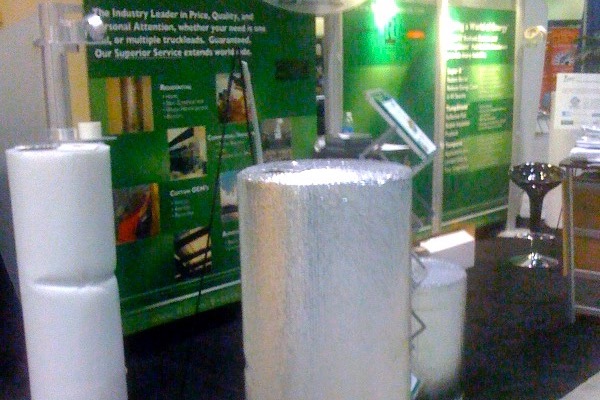
When I wrote about my trip to the Southeast Building Conference (SEBC) in July, I mentioned how some products on display there really annoyed me because they’re either bad to the bone or overhyped. The main one in the latter category is foil-faced bubble wrap sold as insulation.
Scott Gibson at Green Building Advisor (GBA) recently wrote an article about foil-faced bubble wrap and did a balanced job of it. He presented the pros and cons and gave anecdotal evidence of this product having solved condensation problems.
I’ll grant that foil-faced bubble wrap has its applications, as the GBA article proclaimed. I’ve just never seen it installed in a way that would allow the product to do what it does best – reduce radiant heat gain.
First of all, let’s be clear. Foil-faced bubble wrap is a radiant barrier. It’s not insulation. A radiant barrier reduces heat transfer by radiation and has two good applications in homes. Insulation reduces heat transfer by conduction, convection, and radiation through solid materials.
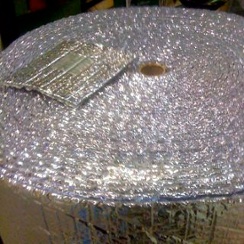
So, when I walked up to the bubble wrap booth and asked the guy what the R-value of it was, he immediately said 15.4. I told him, no, it’s R-1, and then he started talking about the thousands of dollars they’ve spent on testing. Pretty soon, he was telling me he didn’t have time to talk with me any more.
Here’s my problem with his claim. When you quote an R-value for a material, you can’t include air spaces. To capture that, you’d be talking about the R-value of an assembly. The R-value for this material is about an R-1.
What they’re trying to claim is the R-value for an assembly, including air gaps, and not just the R-value of the material. Martin Holladay wrote in the GBA forum, “The claim that bubble wrap is equivalent to R-6 duct insulation is a scam and a fraud.” And these guys at SEBC are claiming R-15.4!
Nice try, guys, but no cigar. The problem here is that for a radiant barrier to work, it must have an air gap on one side or the other. If they staple this stuff to the underside of the rafters in an attic, it will greatly reduce heat gain in the attic, and the temperature will be about 20 degrees lower. That’s because there’s an air gap.
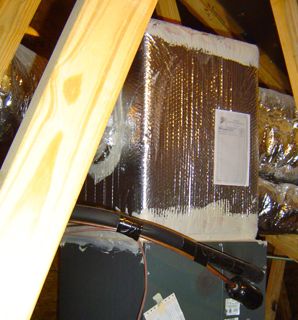
The only place I’ve seen this stuff used is to wrap duct work. I’ve heard of it being used in above grade walls in Florida and on foundation walls of encapsulated crawl spaces, but the former wouldn’t be allowed in Georgia, and I just haven’t seen the latter here.
For bubble wrap to be effective on ducts, the installers would have to put in spacers to keep the bubble wrap from being in contact with the ducts. Not once have I seen spacers on bubble-wrap insulated ducts. Since ducts require either R-6 or R-8 insulation, depending on location, building inspectors should start failing this application every time they see it.
I mentioned above that radiant barriers have two excellent applications in homes, and those are in the attic and in windows, the two places where the most radiant heat gain occurs in a building. In an attic, follow these guidelines:
- Use it only in hot or mixed climates where you have significant cooling loads. It’s a waste of money in a cold climate.
- Install it along the roofline rather than on top of the flat ceiling. In new construction, use a sheathing material with a foil facing, such as LP TechShield or Georgia Pacific’s Thermostat plywood. In existing homes, there are numerous radiant barriers for retrofit, such as PolarPly or foil-faced bubble wrap.
- Make sure to leave an air gap. If you install a radiant barrier roof deck and then spray foam on it, you’ve wasted your money on the radiant barrier because there’s no air gap, and all the heat just conducts right through it.
In windows, radiant barriers are called low-e coatings, but they work on exactly the same principle – by installing a material with a low emissivity between where the heat is coming from and where you don’t want it to go. Foil-faced bubble wrap does NOT work for this application. Well, I guess it could be used here – if you didn’t care about getting light or views through your windows.
If you want to go a little deeper, you can read Martin Holladay’s article called Understanding R-Value or this Radiant Barrier Fact Sheet from Oak Ridge National Laboratory, which does a lot of good research on buildings.
Update: Martin Holladay wrote another article about this stuff in 2014: Stay Away from Foil-Faced Bubble Wrap.
2023 update. I’ve made a couple of minor revisions to the article. Also, my apologies for the low resolution of the lead photo of their booth. It was 2010 and I was using my second generation iPhone.
Allison A. Bailes III, PhD is a speaker, writer, building science consultant, and the founder of Energy Vanguard in Decatur, Georgia. He has a doctorate in physics and is the author of a popular book on building science. He also writes the Energy Vanguard Blog. For more updates, you can subscribe to our newsletter and follow him on LinkedIn.
Related Articles
Oooh, Shiny Stuff! – Radiant Barrier Fundamentals
This Playground Slide Can Give You a ‘Feel’ for Building Science
Comments are closed.
This Post Has 29 Comments
Comments are closed.
Timely indeed. I was just in
Timely indeed. I was just in a crawl space that had this bubble wrap type of silver material wrapping the ducts there. It was a recent installation and i hadn’t seen it before. No i am having to go back and verify what it was but it would make sense to me that these ducts are simply not insulated. They are not well sealed and there was a good amount of condensation on the underside of the duct wrap! thanks Allison!
Outstanding article Allison.
Outstanding article Allison. The sham of counting F-F B.W. as insulation has gone on long enough. Your distinction of the product NOT working in cold climate attics is right on as well.
“For bubble wrap to be
“For bubble wrap to be effective on ducts, the installers would have to put in spacers to keep the bubble wrap from being in contact with the ducts.” Is this true? If the reflective (low emissivity) side of the insulation faces outward, wouldn’t this produce a radiant barrier, similar to TechShield?
Good article Allison. &
Good article Allison.
There is a lot of misconceptions out there and the radiant barrier people are running wide open with the opportunities at hand. Your article states very clearly how to use this product and debunks the myths of R-value they tout. I have used the bubble wrap on ducts before, but did use the 3″ wide spacers (which were the same bubble wrap) spaced every 12 to 18 inches. It seemed to work well, but I am uncertain of any R-value because as you state there is none. Do you recommend regular R-8 with foil backed fiberglass for wrapping ducts? Do you still put spacers with this application? I think having the fiberglass touching the ducts would be a means of immediate conduction.
Thanks for the article and spreading the word about radiant barrier baloney.
Just to clarify my 3″
Just to clarify my 3″ wide spacers for the Bubble Wrap over ducts. I used the same bubble wrap material and cut 3″ wide strips which is not a 3″ wide air space. These strips were placed under each hanger, each joint of the bubble wrap that goes over the spacers, and them in all the gaps in between these areas. I also see a problem of the HVAC guys placing their duct hanging straps outside of the insulation which immediately crushes the R-value to 0! Lots of opportunities to get better IMO!
Wow! This is a popular topic.
Wow! This is a popular topic.
Howard, yeah, go back and check that duct insulation. If it’s bubble wrap with no spacers, that could definitely cause condensation in a crawl space, especially in Hilton Head and especially if there’s duct leakage on the supply side.
Justin, thanks! I agree that this sham has gone on long enough. Actually, it’s been too long.
Jamie, thanks for your explanation of how to get the air gap between the ducts and the bubble wrap. Installers who do it this way can get the radiant barrier benefit of this product. Make sure that the bubble wrap is sealed air tight, too, because unconditioned air leaking in under the insulation will defeat the purpose of the bubble wrap.
Dave, it’s easy to get
Dave, it’s easy to get confused about this because if someone wraps the ducts with bubble wrap, there IS an air gap on one side, as you say. The problem lies in which direction the heat comes from.
I said above that if you’re going to use a radiant barrier in an attic, you should put it at the roofline, not on the flat ceiling. The reason is that the radiant heat is coming from the roof, and you’re trying to stop it from getting into the attic.
With ducts, foil-faced bubble wrap will work as a radiant barrier in the winter when the ducts are moving warm air and the surrounding space is cold. The bubble wrap foil heats up but doesn’t radiate that heat to the attic.
Unfortunately, that same bubble wrap is in contact with very cold air, and the heat flow by conduction is NOT affected by the radiant barrier properties of the foil. As I mentioned in the article, the bubble wrap itself is about an R-1, and that’s just because of the air trapped in the bubbles.
Reducing heat flow by conduction is where the air gap comes in, which adds R-value due to the trapped air. Because it’s a big air space, however, it won’t be as effective as fiberglass filling that gap because of the larger convective loops.
In summer, foil-faced bubble wrap can act as a reflective barrier, just as foil on a flat ceiling can, but you still have the conductive heat gain happening through the bubble wrap.
Allison,
Allison,
Great article! Coincidentally I have been dealing with some foam sheathing products wherein the sales reps. were trying to say it was OK to install on a wall assembly without the min. 3/4″ air gap.
We must be very careful, especially when trying to take credits for these products in energy modeling calcs is situations where the installation does not match up with recommended practice. Vendors can make all the claims in the world but until their claims can be proven AND assimilated into energy modeling software, it will be very tough sell.
One does have to wonder though how many people are fooled by just the type of ploy you described?
Great point, Shawn. When
Great point, Shawn. When doing any type of energy modeling, it’s best to use the most conservative assumption if you aren’t able to verify proper installation.
I didn’t mention it in the article, but it really comes down to the difference between rating a material versus rating an assembly. The R-value of foil-faced bubble wrap is about one. The R-value of an assembly that includes foil-faced bubble wrap could be significantly higher.
Allison,
Allison,
Is there any reason to believe the bubble wrap barrier will outperform a standard radiant barrier in an attic application?
We had a question last week from someone trying to figure whether to pay more for the bubble wrap barrier. Details of what he’s doing here:
http://greenhomeguide.com/askapro/question/is-there-a-strong-argument-for-using-a-bubble-insulation-or-foil-product-on-trusses-instead-of-just-a-radiant-barrier-to-reduce-attic-temps
Thanks,
Willem.
Allison,
Allison,
What you did to the foil wrap salesperson was entrapment. I love it! Our most popular blog posts have definitely been educating consumers about misleading products. Keep up the good work!
Allison:
Allison:
To be clear, I’m not a proponent of using bubble wrap on ducts. I’m a proponent of not putting ducts in unconditioned spaces.
My point was that an air space between the duct and the bubble wrap does little to change the radiant exchange of the system. It does, as you point out, change the conductive properties. The approximate R-value of the air space would be about 1. After all the trouble of trying to keep the bubble wrap off the ducts, the total R-value would be 2 instead of 1, which may be insufficient to prevent condensation under some conditions. I’m not sure I can agree the air gap makes the system “effective.”
All in all a great column. Thanks for highlighting the issue.
Dave, I agree with you on
Dave, I agree with you on both points. No high performance home should have ducts anywhere BUT in conditioned space.
And, I have difficulty seeing how they’re going to get all the way to R-8, 11, or 15.4. I do think the assembly will have an R-value greater than 2, however. The air gap does greatly reduce heat transfer between the duct and the bubble wrap, via both conduction (because they’re not touching) and radiation (because of the foil facing).
I think you missed a valid
I think you missed a valid application of foil radiant barrier. If you have a radiant heating system with the tubing in aluminum distribution plates on the underside of the subfloor, the radiant barrier foil will prevent heat loss to the basement area. It will be doing exactly as its name implies…acting as a radiant barrier, keeping the heat in the floor where it belongs.
Roger, the radiant barrier
Roger, the radiant barrier may reduce heat loss to the basement, but it certainly won’t prevent it. There will still be plenty of heat loss if the only thing you’re relying on is the radiant barrier. It should be coupled with insulation to reduce heat loss by conduction, too.
Allison,
Allison,
Thanks for your comment in reference to reducing heat loss to the basement using radiant barrier. I do agree that adding insulation would be beneficial as well. I do wonder though if you have an opinion as to how much heat loss the radiant barrier alone would prevent…ie 70-80% vs. maybe 90-95% adding insulation with radiant barrier?
Roger, no, I don’t have a
Roger, no, I don’t have a good feel for that, but I think the effect of the radiant barrier would be weaker than the 70-80% you suggest. It would depend on the configuration and the temperatures involved. Great idea for a research project, though!
As an energy rater myself I
As an energy rater myself I have stated very similar arguments against the product as you have detailed here. Like SPF, when installed correctly and in the right application, it works very well. However, when it isn’t, well, obviously you’ve wasted your money. But I’m having difficulty agreeing with the argument that it doesn’t work on duct-work unless its has spacers separating it from the ducts. Spacers would cause it to have 2 exposed sides, but it already has one exposed side with or w/o the spacers. If one side requires at least an inch air-space (same with exterior walls where the air-gap is to the outside before the bricks) aren’t we getting the positive effects of this “one side air gap?” I certainly understand the R-value argument (or the “not really R-value” argument, since I’ve state that myself) but if it already has the air gap then I’m trying to figure out if you are stating that it still “doesn’t really” have an R-value, or that the reflective low-e quality – and purpose – of the material is not working correctly?
Foils do not use R-values as
Foils do not use R-values as you state but they do use a K-value which can be converted into R-value just like Kwh can be converted into btus. I use a foil-backed insulation which is way better than just regular insulation. From the research I have done a K-19 value equals an R-5.6. So by that logic if you wrap ducts with the Double Bubble foil then you would have your R-6. If you are trying to say that foils do nothing than I have to totally disagree with you and you should do more research.
I used a product from a place
I used a product from a place called insulation4less called foil/foam/foil. Not bubble wrap in between, but a 1/4″ of foam. I placed it on a south facing exterior wall (below the siding). The interior surface of the wall was cool to the touch when in full sun (in Arkansas), the second story wall had not yet had the Foil/Foam/Foil layer installed, and it was so hot on the interior surface it was uncomfortable to touch. Also, for fun, I had two attic duct runs to install. I did one with the standard fiberglass duct wrap, and one with the foil/foam/foil. Once the A/C was fired up, I measured the air temp at the discharge of each duct, the FFF air was cooler. I’m a firm believer in FFF.
One point to make here, R-values may or may not be relevant, especially when comparing different types of insulation. The formula is flawed as it is heavily influenced by the fiberglass industry. Other insulations like blown in cellulose perform much better in the real world, but the way R-values are calculated, they do not show that much better than fiberglass. I personally feel putting the fiberglass in the walls that had the FFF on the exterior was of minimal benefit, those wall simply never got hot so convection in the wall would be minimal (fiberglass does not stop convection, which is why I prefer cellulose)… it was amazing. The monthly cooling cost for the 1000 sq. ft. guest house is $80.
Thanks for the article and
Thanks for the article and discussion.
How would it work if 2×6 wall with fiberglass, on the inside surface 30mm polyurethane with foil both sides, then 30mm gap (1×4) and then drywall?
Thanks,
Tony
Need help.Have older raised
Need help.Have older raised home in South Louisiana and remodeling.Want to insulate crawl space….What are my best and least expensive options
Hi folks,
Hi folks,
I am a mechanical engineer and have some knowledge and experience under my belt(~30 years).
When many years ago I bought thermal windows the std was the distance between the panes had to be <13/16″ so that air current eddies could not form and create heat transfer between them by convection.
I am now building a model to prove that the reflective properties of the two foil or electrostatically deposited metallic surface of the two outer layers will suffice in reducing the Heat Loss from one side to the other of the 2×4 wall w/o any other insulation.
I will test through winter and summer in southern AZ climate.
Int Temp @ 70 deg F and Ext Temp whatever the Lord gives me.
I will settle this discussion once and for all and myself!
If 97% Reflection means that 97% of the Heat is being Reflected Both Ways then the total Heat Loss will be nothing compared to what we pay in Heating & Cooling bills all year Long.The only problem is to make sure condensation, if any, is eliminated by adequate Flow Through Ventilation
Hi I wondered if – you lag
Hi I wondered if – you lag between the roof line joists with plastic fleece, then used foil bubble wrap over the top – will this be effective? I have used the fleece which has already helped with conduction, but was thinking of lagging over the top of it with this stuff to aid convection through drafts, and heat radiation. Im thinking it should be very effetive as i have created an air gap with the fleece..
The article you site explains
The article you site explains r, value as, “Some manufacturers of radiant barriers falsely claim that R-value measures only conductive heat flow while ignoring the other two heat-flow mechanisms, convection and radiation. In fact, R-values include all three heat-transfer mechanisms.” your article contradicts this ” Here’s my problem with his claim. R-value is for conduction. The reduced heat flow by conduction through this product is due solely to the air trapped in the bubble wrap. That yields about an R-1. What they’re trying to claim is that the reduction in heat transfer by radiation can be included in the R-value.” , Perhaps you did not add this to the article, “If you want to go a little deeper, you can read Martin Holladay’s article called Understanding R-Value or this Radiant Barrier Fact Sheet from Oak Ridge National Laboratory, which does a lot of good research on buildings.”
Kevin:
Kevin: Thank you for your comment. I was wrong and have revised the article. Sorry. It’s been a while since I wrote this article, but it’s still true that foil-faced bubble wrap R-values are exaggerated all the time. See Martin Holladay’s latest article on this topic: Stay Away from Foil-Faced Bubble Wrap.
It’s used to prevent
It’s used to prevent condensation on air conditioned duct in warm spaces , and yeah it works
This is first time seeking
This is first time seeking info in this manner so please bear with. I am renovating old pressure treated wood basement. Basement walls are insulated with fibreglass and vapor barrier.There is fiberglass insulation in the joist space between floor of upstairs and ceiling of basement but no vapor barrier. Very difficult space to work with. I have some foil bubble back (bubble wrap sandwiched between foil on both sides) Would there be any problems with using the foil back in this joist space as a replacement for a vapor barrier over top the fiberglass that is already there. Previous owner has just stuffed pieces of cardboard in there that don’t appear to serving any real purpose.
I have a 1971 Mobile Home. I
I have a 1971 Mobile Home. I added cotton insulation made from Blue Jeans, advertised as a good sound barrier. Wisconsin had a darn cold winter, so I am adding 2″ of pink foam for an added R-10. My Home has zero out side sheathing. I plan 5/16th particle board sheathing covered in Heavy Duty Reynolds Wrap. I am now looking for a good bubble wrap or another choice of foam. So for a good 6″ wall.Sideing, yet to be chosen, Aluminum foil, aplied to 5/16th particle board, then 2″ corning Foamula R-10 & between studs 3.5 of Ultra Touch Denim Insulation. Now after the tin foil clad particle board. I was think to place 3/8th shims for an air pocket that would allow convection heat to be controled as a insulating factor of it’s self. As I have read, researching this insulation topic. The Denim insulation, also has the electricity wire running in & through it. I hope to change to 10 guage wire. Because that can reduce electrical costs. By reducing the draw on the wire & causing the wire jacket to heat up & subsequently having to pay Money to heat the wires in my walls. Added tip for you energy conservants.. So I think my question is? Is Bubble wrap in a thin layer like half inch or scaller worth the trouble.. Scientificly, one poster said that some static ocurred between the 2 sheets of foil. That I found very interesting. Perhaps some layered materials can be plugged into electric grid & create a cooling or heating effect at a trickle current. Orgone energy blankets cause dehidration & a cooling effect to the air. The Giza Pyramid as known to be extra dry & cool inside. Thanks for the info on Foil Faced Bubble wrap. It sound great for a Mobile Home.I’d say more,but most people keep it short.