
This Playground Slide Can Give You a Feel for Building Science
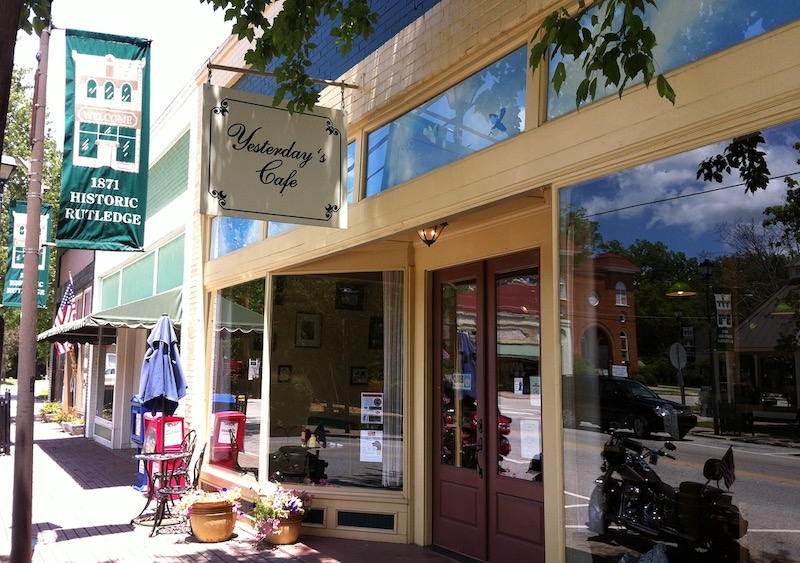
Remember those old metal playground slides? You don’t see them all that much anymore, but recently I found one. It was in the quaint little Southern town of Rutledge, Georgia, near the Hard Labor Creek Blueberry Farm where I’d been picking blueberries one Saturday morning. Right there in the town square was a playground with the beauty you see below.
Doesn’t that just bring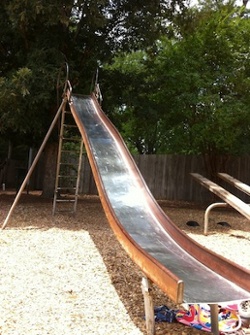 back the memories! Oh, it was so fun to go to a good playground and go down the slides. They were always better than the backyard swingset slides that we all had, mainly because they were taller. The one at Hermann Park in Houston was great! Not only was it really high, but the stairs took you up inside a rocket skeleton, and the slide came out the side. I recall climbing up those stairs with great anticipation, but early on, I learned the burning lesson of metal slides: Feel before you leap!
That’s right, even though I couldn’t feel the heat emanating from the surface of the slide, if it had been in the hot, Houston sun for a while, that slide was going to be HOT! So I couldn’t just put my hand near the metal. I had to touch it. And I definitely didn’t want to put my bare legs on it without finding out how hot it was.
Why? Because even though the metal sat there in the sun absorbing heat, it didn’t radiate the heat away like a hot asphalt road would. It just sucked up the heat and held onto it. But it would definitely conduct it, which many of us learned the hard way by jumping on it too quickly.
How does this have anything to do with building science, you ask? Well, that property of a material that holds onto heat except by direct contact is something that’s been exploited in some building products. Since it doesn’t emit heat, we call it a low emissivity material, or just low-e material for short. Radiant heat gain in homes is mainly a problem in two places: roofs and windows. In the former, some people use low-e materials under the roof deck and call them radiant barriers, as shown below. In the latter, low-e materials are put onto window glazing as extremely thin layers.
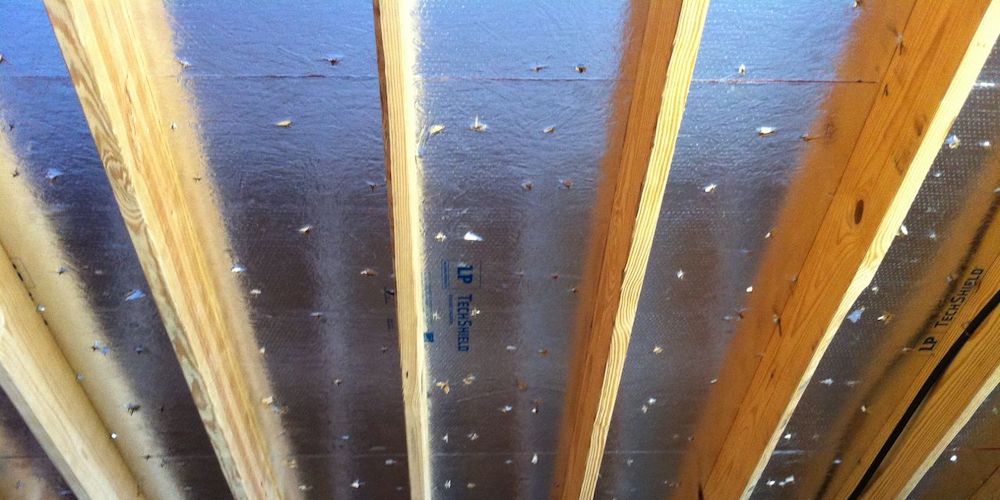
As I explained in an article on radiant barrier fundamentals last year, the heat conducts downward through the roofing materials and gets stuck when it hits the radiant barrier. These things are not for cold climates, however. Even in a hot climate like Houston, their savings may be small. Michael Blasnik found that they saved about 3% of the cooling consumption in tight, well-insulated new homes. The potential savings are higher for retrofits of leaky, poorly insulated existing homes.
Still, it’s interesting building science, and now you’ve found out that if you also learned the burning lesson of metal slides, you’ve known something about building science for a long time. So congratulate yourself for your practical and hard-earned knowledge.
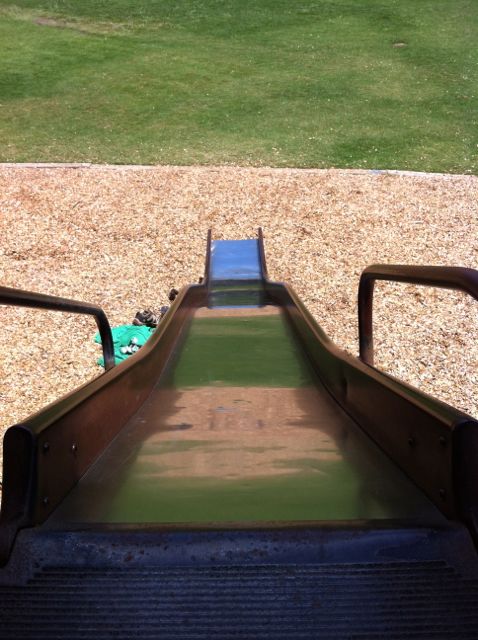
And let’s celebrate by going down that slide!
Allison A. Bailes III, PhD is a speaker, writer, building science consultant, and the founder of Energy Vanguard in Decatur, Georgia. He has a doctorate in physics and is the author of a popular book on building science. He also writes the Energy Vanguard Blog. You can follow him on Twitter at @EnergyVanguard.
Related Articles
Oooh, Shiny Stuff! – Radiant Barrier Fundamentals
Are Radiant Barriers Cost Effective in New Homes?
Radiant Barriers Don’t Work with Spray Foam Insulation on Them
How Hot Is Your Roof? – Insulated Rooflines and Shingle Temperature
Comments are closed.
This Post Has 14 Comments
Comments are closed.
There’s an old metal slide
There’s an old metal slide about 500 feet from my house. We just tried it a few weeks back. It was hot. And also a lot slower than I remember. Also, my dog didn’t enjoy it very much. Thanks for the chuckle and the random BS! (Feel free to interpret that as you will.)
Nate: The
Nate: The key to speed is to use something that cuts the friction, like a towel or a bath mat (with the rubbery side up, not down). When I was a kid in Houston, a slide business sprang up in different locations around the city. They had huge slides with probably a dozen lanes or so and maybe two stories high. You’d pay, walk up the stairs, and slide down on some kind of a mat they gave you. The mat helped a lot!
Per your article Michael
Per your article Michael Blasnik found a savings of 3% of cooling in a hot climate like cooling. Earlier research such as FSEC (Florida Solar Energy Center) reported 8-12%. All the prior research I have heard of, seems to support about that number. Can you shed some light on why Blasnik reported a different number?
Separately I have been told the majority of savings comes from reducing duct losses. Still, duct losses are typically so large that it does not take much to add up to 3% of total cooling load.
Upon installing old style sheet radiant barrier in my own home, there appear to be savings compatible with that 10%. I am fairly convinced 3% would have been lost in the noise and I would not have seen anything without a controlled experiment or some dense statistical analysis.
Thank you.
This is getting interesting.
This is getting interesting. I saw your reference to Blasnik on the Houston study. And… I found a 2008 presentation where Blasnik stated “…radiant barriers or cool roofs if ducts are in attic
►save ~10%-20% of cooling load…”.
You may want to look at this PDF titled “Mythbusters: What Works, what saves”? on page 11:
http://www.energyandutilityconference.org/Assets/2008%20Conference/2008%20Presentations/2008_Michael%20Blasnik_3B.pdf
I am led toward the conclusion that we are seeing conflicting research reports. Yes it is confusing but that also makes it interesting to try to ferret out the truth.
Funny, at the same time you
Funny, at the same time you were sliding in Houston, I was sliding down a similar metal slide in this little playground somewhere near a corner of Victory Drive in Savannah, GA, where my mom would take me when we were visiting my great aunt. Same situation: Very hot sunny area; fun until you came in contact with the metal.
BTW, you can also reduce friction by laying flat on your back, if you don’t mind bonking the back of your head on the seams (I re-discovered this as an adult on a water slide some years back, where I stupidly sat up and couldn’t figure out why I wasn’t sliding!)
I listened to a Webinar a
I listened to a Webinar a couple months ago where a proponent of radiant barriers was describing their product’s operation. He described how the heat radiated downward from the roof would be reflected by the material into the 3/4″ space between the roof deck and the reflecting material – but there was no test data as to what that space’s temperature would be – just that the heat would be “dissipated”. I think I could see (intuitively) how a 2-roof system – with reflective barrier on the top of the inner roof – might work as it would be reflecting solar heat gain into the ventilation space between the 2 roofs instead of the attic, but I’d also like to see some experimental research data on it. I suspect that the end result will be that you cannot beat reflective roofing surfaces for solar gain reduction.
OK Allison, you have to admit
OK Allison, you have to admit it, while the slides in Hermann Park were cool (or hot as you describe), the mini-train was way cooler! Wound all the way around the duck pond. Every time we went to the zoo required a ride on the mini train. Remember
the “engineer” with the official engineers cap? Probably a thing of
the past now. Haven’t been to the Hermann Park area in decades. Thanks for jogging a summer memory!
I just can’t pass this up!
I just can’t pass this up! Our playground slides were in Minnesota where they didn’t get very hot. We solved the friction problem by saving the waxed paper from our lunch sandwiches to wax the slide! I don’t think today’s plastic bags would do the same. And didn’t you just love the merry-go-rounds?
M. Johnson — Actually, there
M. Johnson — Actually, there is no contradiction. The Houston study was of Energy Star homes which had tight and well insulated ducts and good ceiling insulation and so the savings potential for radiant barriers was much lower. The other presentation you cite was based on estimated retrofit savings for existing homes with not very tight or well insulated ducts or ceiling.
Asking for a single number for radiant barrier savings is like asking what adding R-19 to your attic will save. The answer very much depends on the existing conditions. If you start with R-38 then you wouldn’t save much compared to if you started with no insulation.
Allison, I pondered this for
Allison, I pondered this for awhile and came to the conclusion that the reference to building science was that it has its ups and downs. You climb to the top and the next thing you know … swittpt blam! By the way, the slides in Central Park were all metal and there was nothing soft to land on at the bottom. Asphalt, baby! NYC people are tough.
@MJ: in addition to Blasnik’s
@MJ: in addition to Blasnik’s presentation, I believe the FSEC study you mentioned was based on retrofit in not-so-great homes (maybe MB’s citation was based on that study).
The thing is, retrofitting a radiant barrier is seriously expensive laborwise. Can’t imagine it would be the best use of client’s money if attic plane or ducts haven’t first been sealed. But once you’ve take care of that…
Do the numbers and you’ll see it just doesn’t pencil out, except perhaps for DIY’ers. I’d like to know what you’d need to charge to install a RB in my attic.
In new construction, a radiant barrier adds less than 10 cents per ft2 when factory applied to the roof sheathing. That might have a decent payback in a hot climate like Houston.
Okay, it appears I glossed
Okay, it appears I glossed over the term “… in tight, well-insulated new homes” when referring to the effectiveness of radiant barrier. Living in Texas I figured those things were pretty scarce. I would really like to get a clear picture on what proportion of new and old homes can be described as such.
I understand spray-on RB is the labor saving choice for retrofits, about 75-80% as effective as the foil type (in addition to covering rafters too). Would such a retrofit really be more expensive than getting the ducts and ceiling plane sealed? I have had difficulty even getting a reasonable quote for the latter.
I understand Building Science people like to talk about the ideal, about new construction with good air sealing everywhere and maybe even ductwork in enclosed space. My concern is, 99% of us live in something very different and studies focusing on retrofits is so very valuable.
MJ wrote:
MJ wrote:
> Living in Texas I figured those things were pretty scarce.
I’m sure that’s true.
> Would such a retrofit really be more expensive than getting the ducts and ceiling plane sealed?
I don’t know what the spray-on stuff costs, but I’ll eat my shoe if it’s a better value. Also, I recall a report that indicated the performance is much worse than you suggest.
> Building Science people like to talk about the ideal
I’ll admit my focus is new builds, but ideal? I don’t think so. I’m all about finding value, not perfection.
Railroad is still going
Railroad is still going strong at Hermann Park. http://www.hermannpark.org/railroad.php . Lots of other cool stuff there now.