
A 20 Year Old Energy Efficient House Goes to Net Zero in Florida
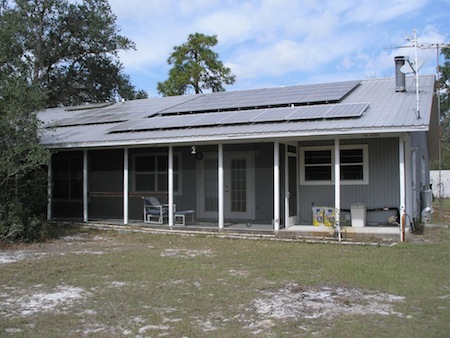
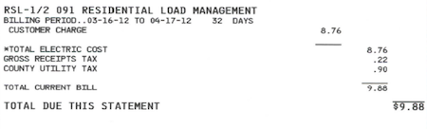
Steve Larson, a builder and home energy rater in Florida, recently sent me an email with his energy bills for February through July of this year. When you subtract out the monthly service charges, he paid only $5.35 for electricity during those six months. That’s right — less than a dollar a month for electricty…and then $9.88 a month for the service charge. “Saving energy has been my passion for a long time,” Larson wrote. Since he added the solar electric system to the house in 2008, producing it has become a passion, too.
Steve Larson, a builder and home energy rater in Florida, recently sent me an email with his energy bills for February through July of this year. When you subtract out the monthly service charges, he paid only $5.35 for electricity during those six months. That’s right — less than a dollar a month for electricty…and then $9.88 a month for the service charge. “Saving energy has been my passion for a long time,” Larson wrote. Since he added the solar electric system to the house in 2008, producing it has become a passion, too.
He didn’t start with a net zero energy home, which has enough onsite power production to offset the energy consumption, but he did start with a mighty efficient one. Larson built the house in 1991-92 (sounds almost like my green home building project, 2001-03). Here are some of the spec’s that make it so energy efficient:
- 2144 square feet of conditioned floor area
- Walls: R-19 fiberglass batt cavity insulation with R-3 continuous foamboard on the outside
- Advanced framing: 2×6 studs 24″ on center with insulated corners and T-walls (intersections)
- Ceiling: ~R-50 insulation (~R-30 blown fiberglass on top of R-19 fiberglass batts)
- Windows: none on West side, only one on East side, South-facing windows shaded by 6′ porch
- 18 SEER 3 ton air conditioner
- Air leakage: 3.4 ACH50
- Duct leakage: 2.7 cfm25 per 100 square feet of conditioned floor area
- Water heaing: solar
- Orientation: long axis along East-West line
If you have a feel for those numbers, you can tell it’s a pretty good house. Without the photovoltaic modules, the HERS Index for this house is 65. Remember – this house was built 20 years ago! A HERS Index of 65 means it’s 35% more efficient than the same home built to the 2006 International Energy Conservation Code (IECC), so it was 35% better than a code that came 15 years after the house was built!
In 2008, Larson added 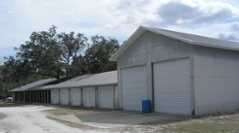 a 5 kilowatt (kW) photovoltaic (PV) system to the house. That didn’t take them all the way to net zero, though because he also has a huge garage and air-conditioned shop. So he added a second 5 kW system in 2010, and that got them to where they are today, paying an electricity bill that’s just $9.88 per month in service charges and rarely any charge for actual net electricity consumption.
In case you’re wondering, the first 5 kW PV system cost $40 thousand, and they got $23 thousand dollars in federal, state, and utility tax credits and rebates. $20 thousand of the incentives came from the state of Florida. The second 5 kW system cost only $28 thousand dollars, a 30% drop in just two years.
The HERS Index of the home including the energy production from the solar modules is an impressive -14. A HERS Index of zero means that the home produces just as much energy as it uses, no more and no less. According to the HERS Index, their home exceeds the net zero energy threshold. “It has been a very comfortable home to live in for the last 20+ years, but the $9.88 electric bills have us in a very nice position. My wife is a very happy camper,” said Larson.
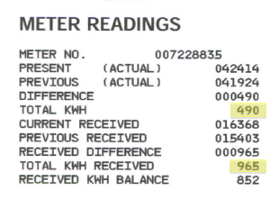 According to the elecricity bills he sent me, Larson’s electricity usage is generally in the range of 500 to nearly 1000 kilowatt-hours, mostly toward the lower end. Some months they produce more electricity than they use, as you see in the meter readings to the left, and other months they use more than they produce. The snippet at left is from their May electricity bill, showing that they used 490 kWh that month while producing 965 kWh. They generally run a surplus, as you can see in the bottom number, which is the running total of their electricity production versus consumption.
Steve and his wife are helping to make Florida’s nickname—the Sunshine State—true in more ways than one. “We are pretty happy how far out in front of the running of the bulls we are,” Steve said. Of course, someone who’s been a HERS rater since 1994 is used to being out in front.
Related Articles
A Net Zero Energy Home in Rural Tennessee
Why Is Air Conditioner Capacity Measured in Tons?
What Would a “Pretty Good House” Look Like? Part 1
Everything You Ever Wanted to Know about the HERS Index
This Post Has 18 Comments
Comments are closed.
Looks great !! I do see that
Looks great !! I do see that he was scared of the manual J calculation (or the 1992 version was just plain wrong), no way that house needs anywhere near 3 tons of cooling. The electric bills prove that a 1.5 ton would do the job.
That is great! I hope solar
That is great! I hope solar continues to drop like that, but I hope people don’t take that for granted and put the producer on top of a “non-reducer”.
Regarding Bob’s comments above…How can you size HVAC from electric bills. I am curious.
Nice! I’m curious what their
Nice! I’m curious what their electric bills were before the PV installation. With this efficient home, what is the payback period for the solar?
Wow! This is great! Wife and
Wow! This is great! Wife and I are in the planning stages of a home much smaller then the one in this article. We want to attempt to be off the grid all together. Until now I was wondering if this was a feasible possibility or not, and be cost effective. Great article, keep them comming!
Maybe I’m missing something
Maybe I’m missing something here but isn’t the payback for these PV systems really long? Let’s assume they’re offsetting an average of 750kWh per month. Let’s also assume $0.10 per kWh (I think it’s more like $0.115 in Florida). So $68K of PV divided by $900 per year is a 75 year payback.
I would suggest that rather than funneling the $68K in rebates to one property the money would be better spent on conservation measures that have a larger impact on the community and ultimately conserve more energy in total. If the homeowner wants to drop $68k on a 75 year payback that’s great. But there is much, much lower hanging fruit out there that public money should be spent on.
[end rant]
Bob: How
Bob: How he decided on the size of the air conditioner is one of the pieces of info that I don’t have about the home (yet). I do agree that it looks oversized from the info I know now and using my rule of thumb, but I don’t have the info to know for sure.
Jamie K.: Didn’t you mean ‘reducer’ rather than ‘non-reducer’?
Thomas B.: At about the same time they installed the second PV system, they replaced the original AC (probably 10 SEER) with an 18 SEER AC. I don’t know all the numbers, but my rough estimate is that the PV simple payback (which is irrelevant, by the way, if you’re not paying cash) is probably in the 40 to 50 year range.
Ken B.: Going off-the-grid is going to be more expensive because you’ll also need an energy storage system — batteries. That adds a lot to the expense and maintenance of the system. You should check out Home Power Magazine if you want to learn more about renewable energy and off-the-grid living.
Darrel T.:
Darrel T.: I was hoping someone would spot this so we could discuss it here. No, you’re not missing anything except that your payback didn’t factor in the incentives. Using your estimated annual energy cost of $900 and $45,000 system cost, I calculate a 50 year payback with incentives. As I mentioned above, though, payback is irrelevant when you’re financing something; it’s all about cash flow in that case.
Also, your comment seems to indicate that you misread what I said about their incentives. They got $23,000 back on the $40k system and much less (don’t know the number yet) on the $28k system.
You do raise a valid point, though, and it’s certainly worth talking about cost-effectiveness and payback. If everyone did only those things that were cost-effective, we wouldn’t get very far with expensive new technologies. The early adopters are a necessary part of the process, so if the Steve Larsons of the world want to spend money solar energy systems that aren’t cost-effective, I say let them do it. If the government and utilities have the tax credits and rebates out there, I say let’s use them.
Yes, I agree that the incentives available for renewable energy systems and ground-soure (‘geothermal’) heat pumps (which are not renewable energy, IMHO), could be better spent elsewhere, on the ‘much, much lower hanging fruit’ you mention. But these are the incentives we have right now.
Returning to the earlier point, if everyone did only the cost-effective upgrades and improvements, I doubt we’d have a single net-zero energy home.
The A/C sizing by energy bill
The A/C sizing by energy bill is common sense. If they use 500KWH in a month with a 200KWH baseload that leaves 300KWH/mo for AC. If the 3 ton A/C uses 3,000W, that’s 100HRS per month or about 3.3hrs per day. AC units should run a minimum of 6hrs per day during hot weather if they are sized correctly.
Allison, a net meter doesn’t
Allison, a net meter doesn’t measure all of kWh consumed by the house. It can only measure the kWh pulled from the grid. In the bill you showed, 490 kWh was taken from the grid and 965 kWh was returned. What the bill doesn’t show is how much energy the array produced or how much solar energy he didn’t send to the grid.
With a net meter, the only way to know total kWh consumed is to install a separate meter on the array and do some simple math.
Bob wrote:
> The A/C sizing by energy bill is common sense
That’s ridiculous. Aside from the fact that we don’t know how much energy the home used that month, we have no idea what the baseload is. I doubt seriously it’s 200 kWh. Also, an 18 SEER AC probably consumes closer to 1600W on low stage.
We can tell a lot more about the load from the specs listed in the article than from a single bill, or even a whole year’s history.
@Darrell, not sure where you
@Darrell, not sure where you came up with 750 kW/mo, but a 10kW system in central Florida will produce much more than that, perhaps 50% more.
The cost-benefit of PV varies dramatically depending on climate, latitude, siting, electric rates, and state/local incentives. My system as a simple payback of about 6.5 years, and that’s based what I paid in 2010 ($5.30/watt, less incentives). Prices have now below $4/watt. That’s the point of providing incentives. Unlike tax the credit for ground source heat pumps for example, PV incentives have had a huge impact on prices. When the federal tax credit was first enacted, PV was close to $10/watt.
My point is if the house
My point is if the house REALLY needs 3 tons of AC, consumption would be closer to 2,000KWH per month during the summer. Houses that really need 3 tons of cooling don’t have 1,000KWH bills in the summer.
It does make me question how valid the argument is about oversizing causing high electric bills though…
Bob wrote:
Bob wrote:
> If the house REALLY needs 3 tons of AC, consumption would be closer to 2,000KWH per month during the summer. Houses that really need 3 tons of cooling don’t have 1,000KWH bills in the summer.
Again, that’s a ridiculous generalization. We don’t have any idea what his summer utility bills are.
BTW, my house is 20% larger, in SE Arizona, and my AC only consumes just over 2000 during an entire summer! Thermostat setting, setback, overhangs, window treatments and a tight envelope have a big effect.
> It does make me question how valid the argument is about oversizing causing high electric bills though…
Oversizing is less of an issue with two-stage equipment. Also, energy savings isn’t the main reason (or even the second or third reason) for not oversizing. The reasons not to oversize are much more important than just saving energy.
2,000KWH for an entire summer
2,000KWH for an entire summer tells me your system is small or doesn’t run very much. In either case you don’t have much of a cooling load.
Agreed, 2 stage is more about comfort than energy savings. The EER is about the same for a 14SEER or 21 SEER unit. The sad thing about 2 stage units is they are almost always oversized in the real world which ruins much of the comfort benefits.
The Manual J was not
The Manual J was not available in 1992. There is no fear of a Manual J on this end, I do them every day. What is not being considered in the comments is Cubic feet, not just square feet. The 13 SEER (installed in 1992) that was replaced is a 2.5 ton, the new Manual J suggested 2.1 tons(25200 Btuh) and a 2.5 ton was not available in the brand we wanted to install (Lennox). With the cubic feet present (the whole house has vaulted ceilings & averages a little over 10′) a decision was made to go to 3 tons with variable speed fan and 2 speed compressor. It runs plenty long to get full air changes, as every room, other than bathrooms, have returns which were installed in 1992, way before that was in vogue. And also, the kw used as shown has the rest of the systems included, like the well pump, septic lift station. outdoor security lighting, spa, and other items, like an air conditioned shop and a motorhome that stays plugged in to maintain batteries and control the humidity level inside. Trying to decide that the a/c is oversized for the home from the electric bills is probably not a wise decision. And as for cost vs. return, we hashed that out for 20 years and waited until the costs came down to be manageable level and rebates, etc. were available so we thought it was time to do something for the environment. Not every Volt, Prius or other Hybrid will pay for themselves either, but that doesn’t make them a bad investment. Our planet needs those sort of things, and if we all criticize these type of decisions, our children & grandchildren are in for a real nightmare. We designed this home in 1991 with the goal in mind to make a very small footprint on this rock. I have been preaching about sustainability for over 20 years, a lot longer than most. Please rejoice with us we continue to shrink our footprint and make our world a better place. This home has been thought about since the mid 80’s, it did not fly off a CAD last month. And thanks to Allison for telling our story.
A couple of more comments:
A couple of more comments: Our total outlay after incentives was about $37k, and our average bill before the 18 SEER was installed was about $225 in the summer. I have a chart that tracks our use since 1992 and a copy of every bill. It is not hard to figure out, but it is 600 miles from where I am sitting so I will not get specific without being able to quote actual figures. The rest of the issue is this. I am betting $37k that energy rates don’t stay at $.128/kwh for the rest of my life. As energy costs escalate, I really won’t care, as we have built our own infrastructure to produce electricity so I can watch Monday Night Football and not require my power provider to burn coal or split atoms to furnish me with the power to operate my Energy Star TV. At $225/mo ave. over a 20 year period, that’s $2700/year we would be mailing to Progress Energy vs $9.88. Doing the math, that is slightly less than 14 years of payback. WHEN, not if, energy costs escalate, the payback gets shorter. I’ll take that bet and sleep well at night, especially when I go on a fixed income. :).
This is my goal for my 1960’s
This is my goal for my 1960’s house. However I fear that solar panels are far off. Need to finish the envelope improvements first.
Great blog article. I’m
Great blog article. I’m hoping to following in their footsteps! I have a 2,700 sf home in Charlotte, NC that was built in 1984. I got a HERS rating in June that put me at a 71. I’ve since upgraded my water heater and installed a radiant barrier that should put me in the high 60s. I doubt I’ll ever get to net zero due to my lack of south facing roofing (max~2kW or 4kW if those multi-junction panels come out to residential). However, I’ll hope to be net producing in the swing seasons once I go the solar route. Keep up the good work!
“Not every Volt, Prius
“Not every Volt, Prius or other Hybrid will pay for themselves either, but that doesn’t make them a bad investment. Our planet needs those sort of things, and if we all criticize these type of decisions, our children & grandchildren are in for a real nightmare. We designed this home in 1991 with the goal in mind to make a very small footprint on this rock. I have been preaching about sustainability for over 20 years, a lot longer than most. Please rejoice with us we continue to shrink our footprint and make our world a better place.”
Steve Larson for President 2012!