
How to Read a U-Tube Manometer
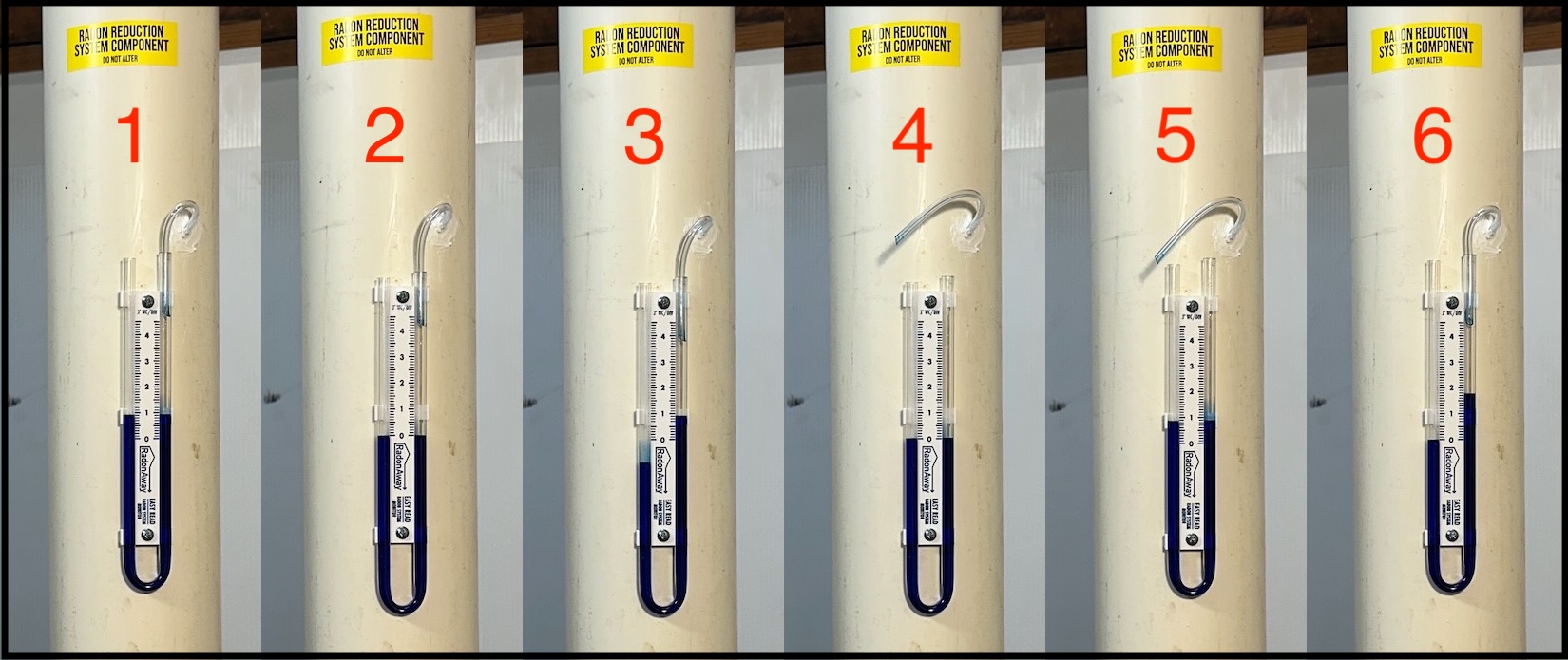
Take a look at the set of photos of the U-tube manometer on my new radon mitigation system above. Can you tell which ones show that the radon fan is on? In which ones would the fan be off? Are there any you can’t tell if the fan is on or off? Do you know which photo shows the manometer set so you can read an accurate pressure off the gauge? If you can’t zoom in to see the photos better, hang on. I’ll go over it all below.
My new radon mitigation system has been operating for 2.5 weeks now. Today, though, I want to focus on one important aspect of radon mitigation and many other things we do in building science: pressure measurements. The purpose of a radon mitigation system is to depressurize the space beneath a basement slab or crawl space membrane. To monitor that you’re getting depressurization, installers normally put in a U-tube manometer. Unfortunately, there’s a lot of bad information about how to read them when you go online for an explanation. And YouTube seems to be a particularly bad place to try to learn about U-tubes.
If you just want the skinny on U-tube manometers, skip down to the last section. There’s also a video to help you understand it.
Absolute, gauge, & differential pressure
Before I get to the specifics, let’s clear up these three types of pressure measurements.
Absolute pressure – This one is just what it says. It’s the pressure relative to zero pressure. When you look at weather reports, it’s what they called atmospheric or barometric pressure, or maybe just pressure.
Gauge pressure – Here we’re talking about a relative pressure, but usually it’s relative to atmospheric pressure. When you measure the pressure in your tires, that’s gauge pressure.
Differential pressure – This is another relative pressure but it’s just the pressure difference between two different places. It could be the pressure difference between the house with a blower door depressurizing the indoors and the attic that could be partially depressurized. It might be the same as gauge pressure, but it doesn’t have to be.
The one we need to understand the U-tube manometer is differential pressure.
Height as pressure
Fluids flow. Put some in a tube, push the fluid on one end, and it flows toward the other end. The Italian scientist Evangelista Torricelli showed this in 1643 (diagram below). He somehow† filled a tube with mercury in a pan of mercury and let gravity and air pressure do their things. With no air in the tube, a gap opened up at the closed end of the tube when he raised it high enough.
![The Torricelli barometer [public domain]](https://www.energyvanguard.com/wp-content/uploads/2026/04/toricelli-barometer-absolute-pressure.png)
“We live submerged at the bottom of an ocean of the element air, which by unquestioned experiments is known to have weight.”
Now, the reason this works is that the height of the fluid (mercury in this case) has a weight. And that weight is balanced by the weight of the whole atmosphere above the open pan. This, it turned out, was the death knell to Aristotle’s, “Nature abhors a vacuum.”
The weight of an inch of water
Now, this method works with differential pressure and other fluids as well. In the world of HVAC, a common unit of pressure is the inch of water column, abbreviated i.w.c. A U-tube manometer contains colored water. When you first install it in a radon mitigation system (or elsewhere), the water on the two sides of the U-tube should be at the same level when both ends of the tube are open to the same air.
Then you connect the open end of a vinyl tube from the radon pipe into the open top of one side of the U-tube. If the radon fan is running, you’ll see the two water levels separate. One goes down. The other goes up. Can you tell which pressure is higher? Yes. The side that goes down experiences higher pressure.
Reading the U-tube
Let’s examine those photos at the top in greater detail now. I labeled the photo below with the relevant parts. First, the U-tube is open at the top of each side. Behind the U-tube is a scale, which goes from 0 to 4 inches for this one. Be sure to note where the zero is. It’s not important for one measurement, but it definitely matters for something else. And then there’s the second piece of tubing that connects the U-tube to the inside of the radon mitigation pipe.
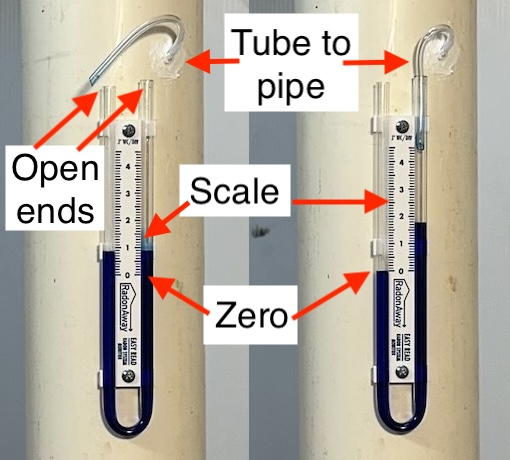
Now we’re ready.
Fan status?
Here are closeups of the first three of the 6 photos from the top of the article.
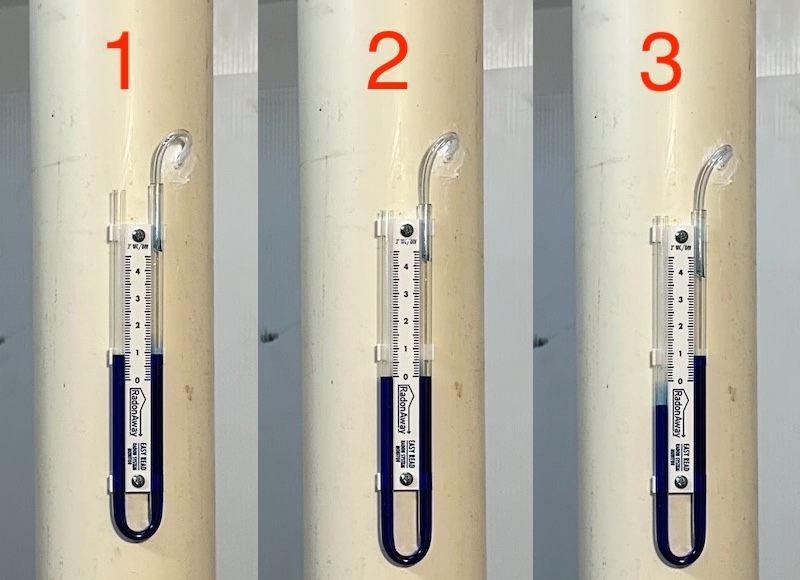
Which one or ones indicate fan on? Only number 3. In all three, the vinyl tube from the radon pipe to the U-tube is plugged in. So each photo shows a measurement of the differential pressure between the radon pipe and my mechanical room. Photos 1 and 2 show no pressure difference. Thus, the pressure in the pipe is the same as in the room. That means the fan is off. In photo 3, there’s a difference in height, so we have a pressure difference. Now the fan is on.
Here are the last three.
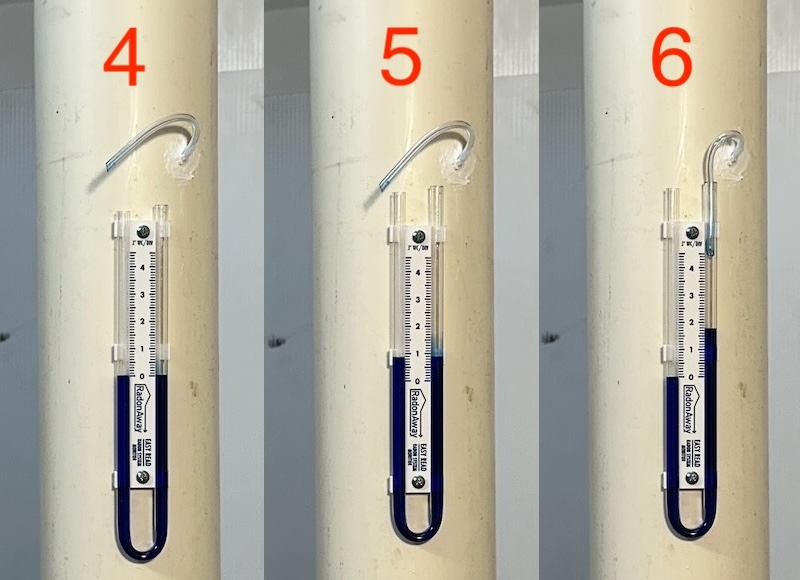
The first two photos show the vinyl tube pulled out of the U-tube, which is now open on both sides. The fan could be on or off. We don’t know which because we’re not detecting the pressure in the pipe. Only number 6 is measuring a differential pressure between the radon pipe and the room. Because the vinyl tube is plugged into the U-tube and there’s a difference in height, we know that the fan is on.
If you’re a homeowner, all you really need to know is that the fan is running. So you look to make sure the vinyl tube is plugged into one side of the manometer and that there’s a difference in height.
Mind the zero
Then there’s the other use of the manometer. Checking to see if it’s doing its job and depressurizing under your foundation is great. But installers also need to make sure they’re not going to burn out the fan, or put it under too much strain. And for that, you need to be able to read the pressure. Regrettably, that’s where there’s so much bad info online.
To read an accurate pressure, you need to set the zero in the right place. To do that, you slide the U-tube up or down. If you set the zero with the fan off (#2) or with the vinyl tube out of the U-tube (#4), you’re going to read the wrong pressure. The fluid in the two sides of the U-tube will be at the same level when you’re not measuring pressure in the manometer.
Then, you make sure the manometer is connected to the radon pipe and that the fan is turned on. At that point, you should see something that looks like either number 3 or number 6. If what you see looks like number 3, you’re likely to read the wrong pressure. You want the liquid on the room pressure side (left here) to be at the zero.
The pressure reading for my radon pipe, then, is 1.8 inches of water column. If I zeroed before connecting the radon pipe to the manometer with the fan on (#3), you’d read half of that, or 0.8 i.w.c.
Don’t burn out the fan
And here’s why the actual pressure matters. Each fan comes with technical specifications that tell you how much air flow you’ll get at different pressure readings. And it also tells you what maximum pressure you shouldn’t exceed.
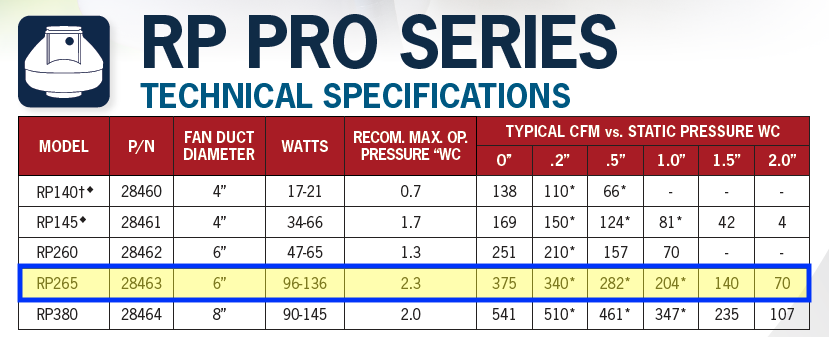
My fan is the RadonAway RP265, highlighted in the table below. It wouldn’t be hard to strain the fan by not resetting the zero after you get it all hooked up. If, for example, my gauge looked like number 3 but the right side were at 2.0 i.w.c., it might seem like it’s within spec. But actually you’d be running the fan at a pressure of 4.0 i.w.c., which is well above the 2.3 i.w.c. maximum pressure they state.
The U-tube manometer skinny
So many people online have gotten this wrong. You don’t need to have followed all the details above because I’ve boiled it down to the essentials here, along with a short video.
- Make sure the U-tube manometer is connected properly, with the vinyl tube from the radon pipe inserted into one side.
- Look for the difference in height to indicate there’s a pressure difference.
- Slide the U-tube up or down to zero the liquid level for the room pressure side of the U-tube.
- Read the pressure on the radon pipe side.
- Compare that reading to the maximum pressure from the manufacturer.
Here’s the video:
How’s your U-tube manometer doing?
† Bill Rose had a great quote about this device in his excellent book, Water in Buildings (affiliate link): “It is always easier to imagine the use of a Torricelli barometer than to actually use one—inverting tall tubes of liquids is quite a challenge.”
Allison A. Bailes III, PhD is a speaker, writer, building science consultant, and the founder of Energy Vanguard in Decatur, Georgia. He has a doctorate in physics and is the author of a bestselling book on building science. He also writes the Energy Vanguard Blog. For more updates, you can follow Allison on LinkedIn and subscribe to Energy Vanguard’s weekly newsletter and YouTube channel.
Related Articles
Radon Mitigation Basics for an Older Home
The Ol’ Beer Can Pressure Crunch
Is Negative Pressure Causing a Problem in Your Home?
Comments are welcome and moderated. Your comment will appear below after approval. To control spam, we close comments after one year.
This is such great nuance beyond “yup the fan is on” that we’ll be able to deploy in the field immediately. A recommendation that we give all of our clients here in Southwest Virginia (Radon Zones 1 -& 2) is that having a radon mitigation system and the fan on (and correctly pressurized per your article), the next important thing is to know that it is doing its job. This requires a continuous radon monitor (we like the Corentium battery operated one that you don’t have to connect to Wifi or a plug). If continuous radon levels are above 2 pC/l then something isn’t working properly. (There can be many reasons for that — we had one large home that needed a second mitigation system.) The short term tests will only tell you if radon levels are high during the time of test, and radon levels fluctuate, sometimes wildly, over time. Influences on higher levels can include higher stack effect pressures (temperature differences, wind, or even low pressure storm events), a tightened building enclosure with unaddressed infiltration via improperly sealed crawlspaces, slab perimeter edges, slab cracks, and more.
Great details, thanks!
You might simply explain the fan is upstream from the manometer, pulling air out of the radon pipe, creationing a negative pressure on the right side of the manometer, while the normal atmospheric pressure pushes the colored water down on the left side of the tube.
A combination of the fan pulling the colored water up the right side and atmospheric pressure pushing it down on the left.
If the left side was in a vacuum, the right side would still go up.
Not unlike sucking on a straw? 😀
Cheers!
Robert
Great article. Few people understand humans live in a fluid.
I have one of those glass Renaissance barometers (don’t believe it’s by Torricelli, his tubes seem more like your manometer). I’ve never calibrated it. It might be interesting to draw a vacuum in the vessel rather than 33.8 feet of water column if I ever get motivated to monitor the weather.
Did you know blue dye is ideal because it’s pigments are typically 100x smaller than other colors, whose big chunks of minerals settle out rather quickly?