
Home Performance Flaw #212: Ducts Placed High in the Attic
The air has been thick with spring for weeks — and I do mean thick. The pollen count in Atlanta this year has set records, our highest getting over 9000. We had a warm winter and a condensed spring. Now the heat of summer is just around the corner, and that means air conditioning here in the Southeast.
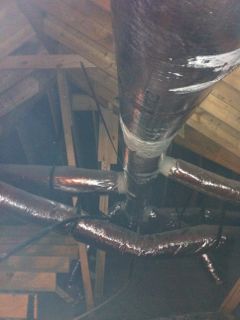
Attics are already heating up. I know because I’ve been in a few, including the one shown in the photo on the left. So, let’s think about what these facts mean.
Attics are getting hot.
People are already turning on air conditioners.
Ducts are in the attic.
D’oh!
OK, we’ve already discussed that putting ducts in the attic in a cooling climate is a dumb idea and will cost the homeowners about 20% extra on their air conditioning bills. Today, I want to point out a way to make ducts in the attic perform even worse. Take a look at where the ducts are in that photo above.
Yep, they’re up high in the attic. Here’s another important fact about attics.
The attic temperature increases a lot with height.
The difference in temperature, ΔT, between the air at the bottom of the attic and up near the roof deck can be 20° F. That means that putting the ducts high in the attic can add 20° F to the ΔT, which means more heat flows from the hot attic into the cold air inside the ducts.
Mistake #1: Putting air conditioning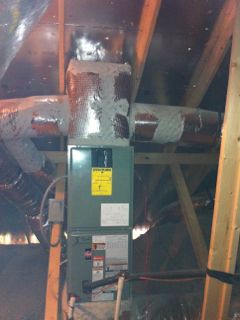 ducts in an unconditioned attic.
Mistake #3: Running the ducts up near the rafters where the temperature is higher.
Why did they make mistake #3? And what was mistake #2? This house had a steep roof, which gave them plenty of headroom in the attic. Someone had the idea to install an upflow air handler (shown at right) because they had the space to do it.
Mistake #2: Installing an upflow air handler.
If you look closely, you can see that not only does this configuration put the ducts high in the hot attic, but the back of that supply plenum is even touching to roof deck. In this house, the roof decking has a radiant barrier, which helps keeps the temperatures a bit lower, but the attic will still be hotter than outside, as it was on the day I was there.
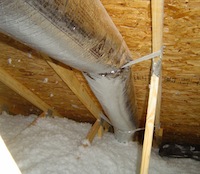 About the only thing they could’ve done worse for the placement of the ducts in this attic would be to run them right up against the hot roof decking, as shown at left. That photo is from a different house, and it’s about the worst thing you can do to ducts in an unconditioned attic.
Mistake #4: Put the ducts right up against the roof deck.
What do you do with problems like this? First, you avoid them with design so you don’t have any ducts in an unconditioned attic. This happens during the design of the house because designing a duct system that works with the rest of the structure and mechanicals is not a trivial matter. We work to prevent this type of problem in our HVAC design practice.
If you’ve already got this problem in your house, it’s more expensive to fix properly. One way would be to encapsulate the attic by putting spray foam insulation along the roofline. Another would be a duct system retrofit to get them into the house or lower in the attic. Retrofitting the duct system just to get it lower in the attic would probably not be cost-effective, though.
Lowering the attic temperature by installing a radiant barrier might be cost-effective in some cases, mainly if it’s easy to install and you do it yourself, I’d think.
If your ducts are high in the attic and poorly insulated, you might want to add more insulation. Of course, if that’s the case, they’re probably also leaky and it might be better in that case to do a complete duct retrofit.
Those are a few ideas on how to overcome the problem. I’m sure our readers have more, so let’s hear them.
Related Articles
5 Good Ways & 1 Bad Way to Get Your Ducts Inside Conditioned Space
This Post Has 34 Comments
Comments are closed.
Hi Allison,
Hi Allison,
Thank you for another great article. I see this more often than not, where they have installed new units in the attic. In fact I had a client that called for an Energy Audit after they did a roof raising (added 2nd floor and attic) to a ranch and had two oversized split AC units installed in the attic with leaky flex ducts. The installer even left out several securing screws for the jacket of the units. The condensing units were not properly installed either. They built some kind of wood deck platform (did not bolt the ledger board to the building) and put these 2 4.5 ton units on the platform right against the house. The house was approximately 1900 sf.
Apparently the company that sold them the AC units did well. The house also had solar PV installed on the roof. But the house was not complete with the rear of the house still open, and only a flimsy door with no weatherstrip or drop seal. They wanted to know why they were still having high energy bills???? And of course they had no door between the not so quite totally finished basement with attached garage, the basement had no heat other than from distribution pipes from the hydronic boiler. And of course the exhaust fan in the bathroom with a shower in the basement was vented right into the laundry/boiler (CAZ) room. The dryer was right in front of the boiler.
These were two attorneys that got upset when I pointed out the problems and said they are taking the builder to court. Lastly, the electric service entrance cables were within 1 foot reach of an open window to the office on the second floor.
You mentioned applying spray foam on the roof decking. Here in the northeast, we have seasons and as much as I understand the science behind it and I do spray foam applications and combinations/hybrids, I want to be sure that I will not be creating a problem such as condensation when using spray foam on the decking (underside).
You also mentioned radiant barriers. For one of my clients, I would like to put radiant barriers up in the attic where his furnace/ac unit is located and increase the level of insulation on the attic floor. We usually put the radiant (foil type) barriers on the rafters and sidewalls, do you recommend laying the bariers on top of the insulation on the floor as well, to encapsulate? This particular attic has soffit vents and gable vents that we will keep exposed/open, since there is no ridge vent.
I appreciate your input. Thank you.
Hi Allison,
Hi Allison,
I designed the HVAC systems for thousands and thousands of houses and trained hundreds of others to do the same. If I designed the duct system in your home, guaranteed it sucks!
We worked on a team for Carrier calling on the top 25 production builders and spent most of our time in Florida, Texas, and California. I recall meetings where we would be fighting over sixty cents a system. High volume RNC is all about lowest cost.
Since we had no idea what direction a house would face, all plans were assumed to face East-West to CYA on the loads. The Houses all got the same duct design regardless of orientation for the same reason. One large contractor even started a soccer club to entice enough migrant labor to install the ducts in the roughly 4-500 houses a week he was doing. So if I did my job right, the AC was oversized at least 75% of the time,the furnace could be 300% to big to get the cfm for the AC, the Ductwork system design was wrong 75% of the time, always installed in hot attics, we were lucky if everything was connected, we installed in the cheapest AC units produced and our competitors had to do the same.
This is why the whole idea of an “assessment” is a big waste of time and money, I know your house Sucks, I designed it.
Pj
I HATE this problem! I fight
I HATE this problem! I fight ice dams in Cleveland and even if it is just air conditioning ductwork in a house with radiant heat, these cause problems in the winter. I tell my customers I can only improve the problem.
My admittedly halfway way of dealing with it is draping fiberglass batts on top of the duct work. Most homeowners don’t want to hear they need to make a $5000 repair to their ducts, and at least some insulation is better than none.
The example you took pictures of is by far the worst I have seen. I’m honestly not sure how they could have screwed it up worse!
I agree. Had they been lower
I agree. Had they been lower and unit been installed as a side discharge system, it would looked better and yes it would be somewhat cooler. But attics like these are usually pretty warm in the summer anywhere from 120-140F if the ventilation isn’t properly done.
Attic should have a properly sized exhaust fan and it looks like most of the supply runs are just sleeve without actual duct. In Chicago area weiss have everything hard piped. This avoids for ductwork falling apart in the future. A better r value insulation may be used. And yes insulating the actuall space between the roof joists will help keep the attic cooler. A main thing to do is exhaust all the hot air from there when temps get to a certain level. Basically have a temp activated fan.
Interesting point. I had
Interesting point. I had never considered the stratification in the attic having an effect on the ducts as well as radiant heat.
Michael, I wouldn’t
Michael, I wouldn’t recommend an attic ventilation fan. It will just pull conditioned air out of the house and into the attic. Imagine yourself on a beach, you will get sunburned on a hot day. If the wind is blowing, you will feel a few degrees cooler and still get sunburned. Seems to help but doesn’t really accomplish much. I’m sure Allison will be along with a link to one of his articles on this.
Nice post and pictures. I was in one of these last Friday. At least everything was connected. The one from last summer, had to take offs that looked connected. Turns out the plastic was, but the flex inside the plastic cover was not, and both were ripped so everything was wide open to the attic.
Debra: Wow
Debra: Wow! It sounds like the contractors picked the wrong homeowners to present a totally screwed up house to. Regarding radiant barriers, I wouldn’t recommend them at all in the Northeast. They help with cooling and only become cost effective in climates that do a lot of air conditioning.
pj: You have an interesting perspective on bad houses, given your background.
Nate A.: Since we don’t have ice dams in Atlanta all that often (OK, pretty much never), I hadn’t thought about the effect of high ducts on that problem. I can definitely see how it’d make things worse.
Michael S.: See my article about power attic ventilators: Don’t Let Your Attic Suck – Power Attic Ventilators Are a Bad Idea
Chris C.: David Butler brings this issue up occasionally, and I’m sure he’ll comment on this one at some point today. Right, David?…David?
John N.: Yep. It’s amazing what you find when you know what to look for.
Allison, It’s funny that you
Allison, It’s funny that you write about this because I was in an attic the other day and they had a ductopus (really more of a ductostarfish) hung within 18″ of the roof deck and they were complaining how the air coming out of the ducts isn’t very cool during the middle of the day.
As far as spray foam vs radiant barrier goes, by the time you air seal, add more insulation, and then add the radiant barrier, it ends up costing the same or more than the spray foam. The performance you get just from putting the equipment and ducts into semi-conditioned space is more than worth it and you reap the benefits year round, unlike radiant barrier.
The idea of placing the
The idea of placing the ductwork under the attic insulation suddenly seems a lot less stupid. It’s amazing how much effort goes into doing these things wrong.
Jon L.: I
Jon L.: I agree. With existing homes, that’s often the easiest solution.
Thomas A.: Ah, but there’s another problem with burying the ducts in the attic insulation. The problem is condensation on the duct insulation wrap, which can then drip down to the ceiling. I’ll explain further in an article that’s coming out probably next month.
At least the ducts in the
At least the ducts in the pictures have the silver jacket which does help some. How about a new house I checked out a couple of months ago with six black supply ducts tucked up between the rafters to go up and over an about to be installed bonus room! I told the builder this was idiocy, but they refused to change it.
Surprising how most people still think you can move radiant heat with air flow. I run into it all the time
John R.:
John R.: If we could just prevent people from doing stupid things, our buildings—and the world—would be a better place. Dark colored ducts would definitely make this situation worse, and putting them against the roof deck is pure idiocy, as you said.
It’s easy to show homeowners
It’s easy to show homeowners the impact. On a hot day, measure the delta-T across the evap coil (measure close to coil), then measure delta-T at the registers (pick a supply line that hugs the roof deck). Subtract the two and divide by the coil delta-T. The resulting percentage represents conducted losses and return leakage.
It’s not unusual to see 20% losses in a horizontal configuration, but an upflow ductopus can lose 40% of cooling energy at perimeter rooms.
The reason contractors do this is obvious. Codes (in many areas) require ducts to be suspended above the insulation (for good reason), and a horizontal configuration costs a little more to install. And the builder, who ultimately calls the shots, doesn’t have to pay the utility bills.
In my experience, informed builders who care about comfort and energy related call-backs don’t allow upflow configuration in the attic. Those who work in new construction should make a point to demonstrate to builders what’s at stake.
David B.:
David B.: Thanks for the numbers! I figured you’d be commenting on this one.
Allison
Allison
Thanks for the reminder about the consequences of burying ducts. I forget about that one.
David
Thanks for the info, that will help put a figure home owners can understand when you are trying to explain to them why the air at the end of a long duct run isn’t cool anymore.
Unfortunately, I’ve had
Unfortunately, I’ve had builders tell me that their code inspectors make them hang the ducts high so not to interfere with the insulation. It’s a mad, mad world.
@Jeffrey, as I noted in my
@Jeffrey, as I noted in my previous comment, codes in some areas (rightfully) require ducts to be suspended above insulation. But the proper way to do this is to hang ducts level so they’re just above top of insulation. I can’t imagine an inspector refusing to allow it done that way.
Another problem with plenums
Another problem with plenums and ducts against the roof deck are the nails used to fasten the roof shingles to the deck, they are required to be long enough to completely pass through the deck and therefore are exposed on the underside. These nails then penetrate the plenums/ducts. In the photos above you would see the nail holes if the plenum and duct had been separated from the deck.
John LaMonte’s comment really
John LaMonte’s comment really nails the solution to the problem, for those conscientious enough to care: the ducts and air handler/evaporator should be within the conditioned space from the beginning, thus reducing the delta T, and allowing for a smaller, properly sized HVAC system to be installed. This also presuposes that the duct connections are properly sealed, so as to prevent air leakage, thus ensuring that all the conditioned air within the system actually makes it to the space being conditioned. This also makes condensation issues into non-issues.
In doing the above, always remember that any insulation, of any type, must be covered with a non-combustible surface, such as ½” drywall gypsum board, and at least fire-taped. That way, any inadvertant air leak will still be within the conditioned space, and there will be a non-combustible barrier between the conditioned space and the insulation and framing/sheathing.
The added cost of doing the system correctly from the beginning is more than offset by the immediate, and long term savings realized over the life of the system.
With respect to the attic
With respect to the attic here in the Northeast, I understand you don’t recommend a radiant barrier. However, I need to give the proper prescription for this client and many like this. 720 sf attic space with HVAC system (horizontal installation) with sheet metal trunk and flex ducts. No ridge vent and no soffit vents, only gable vents, one on each side. There is only some areas of the attic floor with FG insulation. In trying to condition the space for optimum energy efficiency, efficiency of the HVAC unit and comfort, how much spray foam should be used on the roof decking? Leave just the gable vents for combustion/room air?
@Debra, you can’t close an
@Debra, you can’t close an attic that has an atmospheric furnace or water heater. If furnace is close to end of it’s life, replace with sealed combustion and insulate with R28 to R30 on roof deck. Need to remove floor insulation for proper heat transfer to attic from house, to maintain temperature above dew point. If furnace replacement isn’t an option, then seal the ceiling plane and upgrade the floor insulation to R38 or better. But gable vents without soffit vents is not a good situation.
@Debra, I should have made it
@Debra, I should have made it clear that you can’t insulate the roof deck without insulating gable ends and completely sealing off the attic from outside air.
I understand that there needs
I understand that there needs to be makeup air for combustion in the attic for the HVAC.The problem: Only two gable vents (no soffit or ridge vents) We need to seal and insulate the ceiling. Normally we would make the attic floor the thermal and pressure boundary. There is an HVAC system there that is not going to be changed for a few more years (5 -10). The house is extremely leaky and cool. The basement is used as a living space and 1/2 complete. We will be sealing and insulating the basement as well. Normally, if there is no HVAC in the attic we would be sealing off the top plates, sidewalls, ensuring open soffit vents and baffles installed (there are none here only the two gable vents), and we would seal all gaps, properly seal seal and use proper covers for recessed lighting, insulate and wealtherstrip the attic access hatch and add cellulose insulation to at least R49, some get up to R60.
Because there is the HVAC, what is the best way in this case. Allison advised not to use a radiant barrier.
The client is also on a budget so I am trying to come up with the best options. Thanks
@Debra, I agree with Allison
@Debra, I agree with Allison that RB is not cost effective in your climate, and in my opinion, not in any climate when labor is involved. I only specify in new construction when foil-faced OSB can be used (no extra labor). In that case, it works out to less than 10 cents per SF.
As I see it, you have two choices: fix the ceiling (air seal and R-value) or move the air barrier and thermal boundary to the roof deck and gable ends.
There’s one way you can do the latter without replacing atmospheric furnace: build a small combustion zone for the furnace with properly sized vents through the roof (consult mfr for specs).
On some projects, there are no good solutions. About the only way to choose between these options is to model the ceiling and duct loads in both scenarios and compare with cost of implementing. I don’t know what modeling software you use, but few if any handle closed attics properly. I’ve learned how to put bounds on problems like this, and in many cases, that reveals an obvious choice.
Thanks for your input David,
Thanks for your input David, I still need to do something and I want to do the right thing. What is everyone else doing with respect to HVACs in the unconditioned attic?
Allison, I know you are busy, but could you help me out with this one. The client is in Rockland County, NY. Thank you.
We at Advanced Energy have
We at Advanced Energy have found it is wise to install ducts just above the attic insulation. It is important to note that ducts should never be in contact with attic insulation in coastal regions of the SE. The insulation changes the dewpoint of the surface of ducts and condensation can form. The poor HVAC contractor is blamed when the ceiling of the home begins to show water stains. If ducts have to be in the attic it is wise to install them just above the insulation level but no higher.
John T.:
John T.: Welcome to the Energy Vanguard Blog! It’s always nice to have big names in the industry comment here, and you join Joe Lstiburek, Michael Blasnik, and John Proctor in that respect.
Yes, the issue of condensation on ducts in attic insulation is something a lot of people aren’t aware of. Some well meaning people involved with programs have even promoted the practice of burying the ducts in insulation because they didn’t understand the changing dew point. I’ll be writing an article about this topic sometime in the next month.
How about the buried duct
How about the buried duct approach?
http://apps1.eere.energy.gov/buildings/publications/pdfs/building_america/buried_ducts.pdf%20
Grant:
Grant: Burying ducts in the insulation can lead to condensation in humid climates if the insulation is air-permeable. That’s exactly the problem that John Tooley referred to above. I’ll be writing an article about this soon. It might work in a dry climate like Sacramento, but I wouldn’t do it in the Southeast or anywhere that the dew point of attic air can get up into the 70s during cooling season.
Agreed. That link I shared
Agreed. That link I shared shows a detail where the ducts are wet-set in an inch of closed-cell foam, and then hit on the other 3 sides with an inch of closed-cell foam before they are buried in cellulose. Seems like a safe idea…provided the detailing is done correctly.
And the combination of ductwork sealed w/mastic + the CCSF provides some comfort in making sure the ducts are as tight as possible.
thoughts?
Burying ducts is not just a
Burying ducts is not just a condensation risk. It displaces ceiling insulation. The impact is obvious with an IR camera!
I’ve been asked more than once how burying flex ducts can lead to condensation. At first glance, it doesn’t seem possible, but I’ve actually seen the damage first hand.
Here’s what I think is happening: If a duct is resting on the ceiling (e.g., running parallel to joists), and the evaporator is running long cycles at a colder than normal discharge temperature (e.g., the result of clogged filters or restricted ducts), the surface temperature of the outer wrap may drop below the dew point at the duct intersection with the ceiling, which is cooler than the attic. Voila! The outer sleeve begins to sweat.
I’ve heard of ducts being laid on top of the insulation with cardboard dams erected so that more insulation can be blown over the ducts. This addresses the displacement issue, as well as moves the ducts away from the ceiling.
In John T’s comment above, he recommends not allowing ducts to touch the insulation. You can take most anything John says to the bank, but I can’t get my mind around how that would be a condensation risk. In any case, it’s always best to err on the side of caution when it comes to moisture management.
When ducts are in contact
When ducts are in contact with insulation in coastal areas having high dew points as shown below it is not hard to see that the exterior of ducts can operate at or below these temperatures during some portion of the day. Dave B. above is correct when he gave reasons for very low duct temperatures (the result of clogged filters or restricted ducts). Thank goodness homeowners change filters regularly and ducts are always sized properly not to mention dirty coils. Insulation contact allows the duct to stay cooler than being exposed to a hot attic. The perm rating of batts and blown fibrous insulation is very high and in no way retards vapor flow. It is a safe practice in these areas of the country that duct are suspended and supported just above the insulation level. I agree with Dave B., I have seen where portions of the attic could not be insulated due to ducts filling the space. The best is, never install ducts in the attic.
The daily Dew point for Wilmington,NC is 74-76 degrees F in the month of July, Mobile, AL 74-76 degrees in the month of July, St. Miami, FL, 76 degrees in July, Petersburg, Fl, 77-78 degrees in the month of July Source: http://weatherspark.com
Thank you again for another
Thank you again for another” feel good, uplifting, that there are good people in this world story”. We read so many stories that are negavite about people and what they do to others. A random act of kindness is always such a great thing to hear about. Peace and blessings.
Thank you again for another
Thank you again for another” feel good, uplifting, that there are good people in this world story”. We read so many stories that are negavite about people and what they do to others. A random act of kindness is always such a great thing to hear about. Peace and blessings.