
Why Should I Care About the Passive House Program?
This weekend I bought my ticket to Denver for the Passive House conference at the end of September. The program has intrigued me since I first found out about it in 2007, but I haven’t gotten involved with it yet. That may be changing now.
This weekend I bought my ticket to Denver for the Passive House conference at the end of September. The program has intrigued me since I first found out about it in 2007, but I haven’t gotten involved with it yet. That may be changing now.
I made overtures a few years ago and then held back because my involvement with HERS rater training and serving raters as a HERS provider was consuming most of my time. The fact that the program didn’t seem well-suited to warmer climates and received some well-placed criticism from folks like John Straube and Martin Holladay didn’t make me feel like rushing in either. I’m sometimes accused of insisting on the perfect instead of the good (and not only by my wife!), but I do value cost-effectiveness and doing what’s practical. That’s why the Pretty Good House idea appeals to me.
At the Westford Symposium on Building Science (a.k.a., Building Science Summer Camp) a couple of weeks ago, I spoke with Katrin Klingenberg and as a result, decided that I should attend their conference this year. Just getting to hear Amory Lovins and Joe Lstiburek speak makes it worthwhile to attend, of course, but my real objective is to find out where the program is headed.
My Passive House leanings
In the ’80s and ’90s, I was a big fan of Amory Lovins. I remember reading about the house he built in Snowmass, Colorado—with their outrageous 9000 heating degree days—and how they relied mainly on passive solar gain and internal loads for heating the house. In fact, he would thank his guests for their heating contributions. I’d also been fascinated by the superinsulated houses of the ’70s and ’80s.
In a way, Passive House is to heating loads as Grover Norquist is to government — Their goal is to reduce the heating load to such a small size that you could drown it in a bathtub (and thus eliminate the cost of the typically huge mechanical system). I can identify with that…to a point.
I know that that Henry Gifford looks at the building envelope merely as the “assembly surrounding the mechanical system,” but the building envelope has to be where you start. I think the Passive House folks have gone a little too far in trying to design and build “homes without heating systems.” (Martin Holladay showed that that claim isn’t true anyway.) They’ve done a lot of great things to help move the superinsulation model forward, however.
One thing I really like about Passive House is that they account for thermal bridging (places where heat can bypass the insulation) in a more realistic way. By contrast, the HERS energy modeling software factors in thermal bridging mainly through default framing factors for the various building assemblies.
I also like that the ultimate goal is the reduction of primary, or source, energy consumption, and that they have a high standard for air-tightness. Plus, it’s encouraging to see Passive House incorporating HERS raters into the verification process.
My reservations
As I mentioned above, one of my biggest questions about Passive House has been its suitability to warmer climates with humidity. I live in the Southeast where cooling and dehumidification are significant factors. Having a really well insulated and air-tight home with no thermal bridges isn’t going to get you all the way to home plate. Mechanical systems are critical, and I was happy to hear Klingenberg discuss the importance of dehumidification in her Summer Camp talk.
Extreme energy reduction is great, but you also need to make sure that the people who live in the home will be comfortable and healthy. In the latest article in her blog (the Klingenblog), Klingenberg seems to be holding tight to the energy reduction target. As she states there, “refining the annual figure to climate zones will result in a tightening of the standard in some climate zones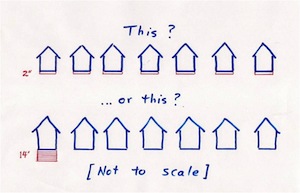 – not a relaxation, as some generally understood the proposal to do.”
I like the way Martin Holladay put it in his diagram explaining the broder goal (shown at right): “You can save a lot more energy by installing 2 inches of foam under 7 houses than by installing 14 inches of foam under one house.”
I’m also concerned about the cost-effectiveness issue. At a certain point, building envelope improvements become more expensive than adding photovoltaic modules to produce energy on-site.
And then there’s the name. Should we call it Passive House or Passivhaus? Or something altogether different since it’s not truly passive, and it’s confusing because of the similarity to passive solar, which Passive Houses don’t have to be.
My hopes
 As Joe Lstiburek said to Klingenberg at the end of her talk this year, “If you want to change the world, this can’t become a boutique program like R2000 in Canada.” I’d argue that he’s wrong in one respect: Passive House is already a boutique program. It’s got a tremendous amount of buzz for a boutique program, however, and its effect cannot be measured simply by the number of certified projects. That buzz could propel it into another realm.
Is Passive House ready for the big time? I’m anxious to find out more when I attend the conference in Denver.
Foam hog sketch by Martin Holladay of Green Building Advisor, used with permission.
This Post Has 11 Comments
Comments are closed.
Allison,
Allison,
While I don’t believe that Passive House will ever get beyond the boutique level the fact that it generates discussion is worthwhile in itself.
“Pretty-good-house”(PGH?) is a more realistic mass market approach but mass market will only get there if there is something at the top to raise the average.
To those of us in the energy efficiency business Passive House keeps our little minds working whether we fully buy into the concept or not.
Even the PGH will need to get better over time. If we don’t think and dream about concepts like net zero and Passive House we don’t move beyond where we are.
BTW, on the name thing; I think the Americanization of the program is a good opportunity to bring the name to English as well. But, as with the envelope/enclosure business I’m not ready to get into the language policing field:)
This housing type has been of
This housing type has been of great interest to me for several years, since its first introduction to me while studying Architecture at Ball State University. Perhaps you are correct and this housing program will not overcome its boutique status, which is problematic. However, I feel that there is a large market base for smaller homes that can perform to the standards of this program and there are a lot of young people who are desiring to live in homes that are 1,200 sq.ft. and cost them very little operate. On a different note, I agree with your thoughts on PV, I think there is a reasonable point at which the insulation properties of the home could be balanced with on-site energy production.
“I’m also concerned
“I’m also concerned about the cost-effectiveness issue. At a certain point, building envelope improvements become more expensive than adding photovoltaic modules to produce energy on-site.”
One my favorite things about PH modelling is that it actually helps you determine where that point is. It definitely won’t incorporate the costs of materials but it will help you accurately determine where the law of diminishing returns applies most when it comes to energy.
If net zero is the goal it’s important to stick to the old mantra of “eat your conservation veggies before your renewable dessert” and I think PH does a very good job of illustrating that point.
I do not have a lot of faith
I do not have a lot of faith in the passive house concept mainly because people value comfort over conservation. Chandler VonSchrader over at Energy Star has a great statistic- “The average US household spends approximatly $400 per month on cable,internet and cell phones but only $200 per month on utilities”, people place a much higher value on conveniece than they do on conservation. A lot of my customers keep their thermostat within about 2 degrees year round and you cannot convince me that a non-mechanicaly conditioned house can do that. Not to mention Alison’s point about humidity.
Bill S.:
Bill S.: Great point! And I agree. Passive House has value beyond the houses that they certify because much of the green building discussion is influenced by, as you say, having “something at the top to raise the average.”
ryan: Yeah, small homes are great, but Martin Holladay pointed out in his article that the PH model has a bias against them. So does HERS.
Ryan S.: Great point! But isn’t it true that PH won’t let you certify a project by meeting part of the energy reduction goal (1 Watt per square meter, which is actually peak load) with PV? Do you use the PHPP to help clients with projects that can’t get certified for this reason?
Jamie: With energy prices as low as they are, it’s certainly hard to justify the extreme energy reduction of the PH program. But for those who are interested in reducing energy use for other reasons, this program holds a lot of appeal. These homes can certainly be comfortable, too, so they don’t have to sacrifice one to get the other.
“Do you use the PHPP to
“Do you use the PHPP to help clients with projects that can’t get certified for this reason?”
Yes, PHPP can be an extremely useful tool for energy efficient design regardless of whether or not the building meets all of the specifications of PH.
My point is that PH design principles and methods should be incorporated into all buildings as a means of reducing the energy loads down to the point where adding renewables will get them over the net zero finish line. Without a dramatic reduction in energy usage net zero isn’t really feasible.
You know how much I love
You know how much I love PassivHaus.
The name is the reason for the buzz, not the standard. Wolfgang should probably be sued for misleading advertising.
The standard is not only problematic in hot humid climates, but also very cold climates (like MN, ND, WI, MT). The formula works for cool, mild, kinda cold, and a little warm. climates.
Then there is the short sighted nature of the standard that clings to a tiny set of metrics and ignores the larger picture entirely. A comparrison to HERS is pretty week. You are comparing a greedy-banking-loan program to geeky-lab-coat. There are energy modeling systems that account for bridging, although one could argue that PH takes it a bit too far in their micro-examination of glazing systems.
At the end of the day, PH is distrubing. It is the tea-party of the already botique energy conservation tribe. It has no place in the mainstream. Engineers have no business designing places to live, love, and engage with nature.
Ryan wrote:
Ryan wrote:
> Without a dramatic reduction in energy usage net zero isn’t really feasible.
That depends on where you happen to live.
As a former designer, I’ll
As a former designer, I’ll throw out another factor why Passivehaus may never become mainstream: the lack of aesthetic concern. Although multiple rooflines, vast expanses of glass and double-height interior spaces are certainly not necessary, most PH houses seem to be little more than highly insulated shoeboxes. I respect the stringent detailing and driven goal for net zero energy use, and beauty is in the eye of the beholder. But PH adherents should take a cue from the hybrid/ electronic auto industry to see how smart design married to smart engineering can break into the popular market.
shtrum’s comment, “most
shtrum’s comment, “most PH houses seem to be little more than highly insulated shoeboxes” held true many years ago, but now that more architects are playing around with this system and getting past the initial learning curve, we are seeing design time spent on the aesthetic portion of these projects. Europe has been doing this longer than us here in the states and we even see “curves” in passive house projects there. Two of my favorite examples here are David Peabody’s American Four Square in Bethesda, Maryland (a wonderful case study can be found on our website http://www.phaus.org/learn/case-studies) and Dennis Wedlick’s Hudson Valley PH (http://www.denniswedlick.com/work/hudsonpassive.html)
It’s just a matter of time as practice and experience produce finesse, and as seen above, it’s happening. I invite you all to attend our 7th Annual North American Passive House Conference in Denver to see the good development of the theory happening on our soil. Many good minds like Katrin Klingenberg and a host of others are in the trenches, continually improving the concept with the issues we have in our variety of North American Climates. Our Passive House Alliance United States is dedicated to supporting this development in an open and honest ongoing dialogue and information sharing. Our mission is to bring PH beyond the boutique category as it brings improved levels of value to many a project.
More information on the conference and the topic of Passive House is found on our website http://www.phaus.org
Thank you for this good dialogue Allison and I will look forward to greeting you in Denver!
Mark A. Miller
Executive Director
Passive House Alliance United States
I’ve decided to spend the
I’ve decided to spend the money to go to the PH conference in Denver as well. Expect I’ll learn a lot and hope to have the chance to meet you. The PH movement in the USA is really cutting costs and several projects have matched standard construction costs by choosing not to make profit. In the cases I know of the builder chose this option as they were excited about the potential.
Things will continue to get interesting.