
The Downspout Fountain: An Unplanned Home “Improvement”
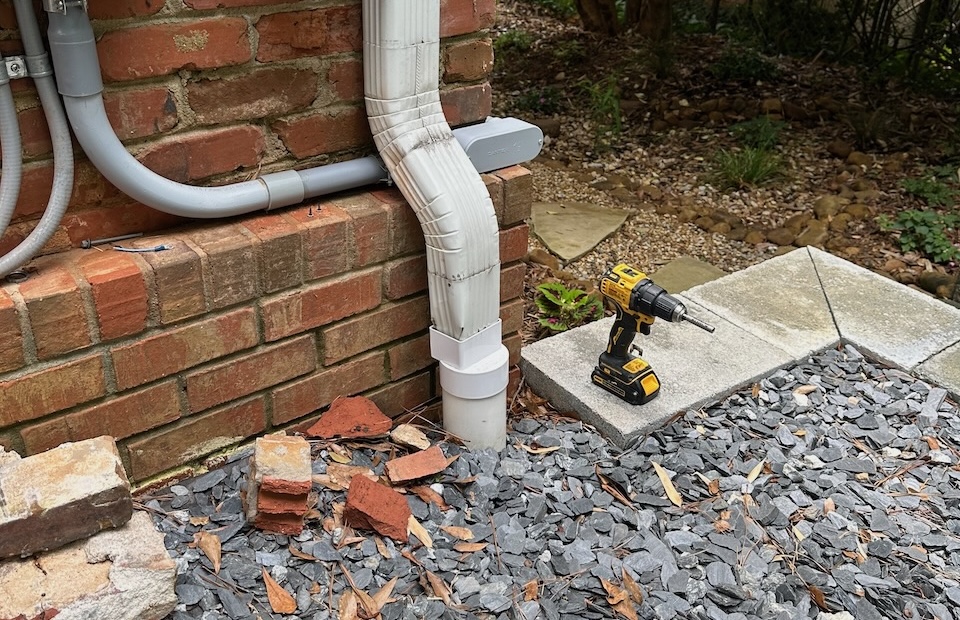
I clean the gutters on my house twice a year—once in early winter to clear the leaves and again in late spring to clear the catkins. I was up there a couple of weeks ago and decided not to bother with the leaf blower to clear the catkins because there was almost nothing in the gutters. Then, after six weeks of no rain, the skies began to open up last week. One afternoon a few days ago, I was looking out of our sunroom windows and saw our new downspout fountain. I’ll go into detail about it below, but here’s a short video about it.
One quick note here about why this matters. Water hitting the side of the house like that and landing right at the foundation can find ways into the walls and into the foundation. Water is the biggest problem with buildings of all types, and you want to get all the rain down and away from the building. That gives you the best chance to avoid rot, mold, high indoor humidity, and other moisture problems.
Understanding flow…or not
The problem here was obvious, at least in hindsight. But let’s start with something I’ve discussed many times here: flow. Fluids flow. If in a container, they take the shape of the container. If on the move, they follow the force. It could be a difference in pressure for air in a house or duct. It could be gravity for water in a vertical pipe. And it likes the pathways of least resistance, which is how we got our downspout fountain.
Turns create more resistance to flow. So do reductions in the area through which the fluid is flowing. And worst of all, debris that clogs the pathway creates a lot of resistance. Our new temporary water feature was the result of a clog. The catkins that I didn’t see in the gutter above had moved down to the constriction. And there they remained until that day when my wife and I marveled at the height of our new downspout fountain.
Anatomy of a water failure
The rainwater in that downspout sprayed up into the air 15 feet above the location of the flow restriction. But it didn’t ride up that high outside the gutter. The water came out of a connection between two vertical pieces two feet below the crest of the fountain.
The flow restriction came at the bottom of the downspout, which you can see in the lead photo above and also below, with some annotations.

The two elbows add resistance to the flow of the water, which makes it harder to clear debris traveling with the rainwater.
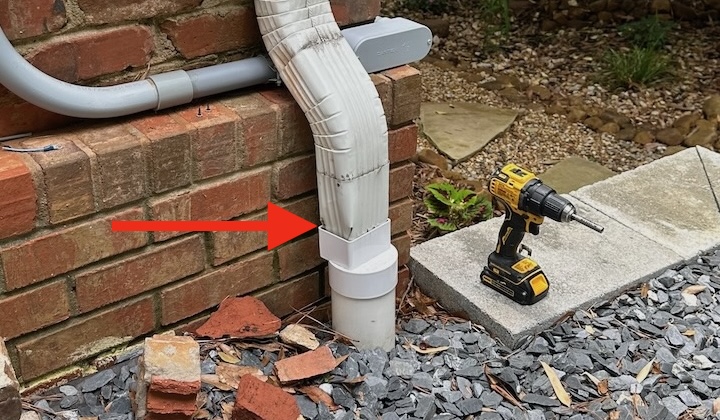
Then there’s this connection of the 4″ x 3″ downspout to the 4-inch pipe carrying the water away underground. You can see that it’s been crimped to fit into that connector. But wait! It gets worse.

The bottom piece was 6 inches of straight downspout. The right side of it was mangled to fit into the connector. But the connection between the straight piece and the second elbow also was bent inward. Ugh!

I forgot to take pictures of how bad it looked before I cleaned it, but you can see in the video above that the debris was packed tightly in there.
Preventing future downspout fountains
All I’ve done so far to fix this is clean it out and open up the area. You can see the result below.

But that’s not all I’ve got planned. Here are my next two changes:
- Better connection. The downspout still reduces the flow area at the connector, so I’ve started looking for a better connector.
- Gutter guards. I’ve resisted gutter guards because they’re often more trouble than they’re worth. Last year, though, I wrote an article about how building science begins outside the house. In the comments, I got some recommendations for a stainless steel micro-mesh gutter guard. Several people said they work well so I’m going to test them on a few of our gutters.
I hope you never see this kind of unplanned downspout fountain at your house. But if you do, look for the restricted area somewhere below the fountain.
On the same day I saw the downspout fountain, I also saw a gutter waterfall. That one also had a clog in the downspout extender at the bottom. I cleared it and a couple days later saw the waterfall again. Turns out that downspout was clogged at top and bottom. I should have known that because it was spilling over the edge of the gutter.
All is well here now. We’re in the flow again. We have no water features of any kind.
Allison A. Bailes III, PhD is a speaker, writer, building science consultant, and the founder of Energy Vanguard in Decatur, Georgia. He has a doctorate in physics and is the author of a bestselling book on building science. He also writes the Energy Vanguard Blog. For more updates, you can follow Allison on LinkedIn and subscribe to Energy Vanguard’s weekly newsletter and YouTube channel.
Related Articles
Building Science Begins in the Yard
Roof Overhangs and Moisture Problems
Design Flaws That Can Rot Your House
Comments are welcome and moderated. Your comment will appear below after approval. To control spam, we close comments after one year.
I had some basic mesh gutter guards installed 7 years ago and have had no issues with clogs. I also installed Barnett’s Valley Controllers (https://www.amazon.com/Barnetts-Roof-Valley-Controllers-Single/dp/B07CC4G4QB) on all valleys. These work great unless you have a gully-washer, in which case they overflow much like the metal guards do. The great advantage is for leaves and other debris. I never have to have the valleys cleaned. It may take some time for all the leaves to be removed by rain, but it works! You can see an informational video here: https://www.youtube.com/watch?v=Zg1KJtVzciI
THANK YOU @Norman Bunn
I’ve got the micro mesh gutter guards from Costco (4.5 years now), and the ONLY problem I have is at my one inside corner. Have you had the Barnett’s Valley controller installed for the entire 7 years you have had the micro mesh? And if so, has it held up fine without the need for adjustment/cleaning etc over those years? If not, how long have you had it installed? I’m almost ready to get one…
FYI, in addition to the micromesh gutter guards, I also have the Leaf Eater “filters”, specifically these
https://rainharvesting.com.au/us/products/rain-heads/leaf-eater-advanced/
and these
https://rainharvesting.com.au/us/products/rain-heads/leaf-eater-ultra/
Even with the micro mesh on the gutters, I am astounded at the amount of debris that the Leaf Eater devices catch.
I have had them at least 6 of the 7 years. I had the firm who was cleaning out my valleys install them and they have been problem-free. As noted in the Amazon comments, they work best when used on valleys with the same pitch on both sides. They will occasionally be overwhelmed, much like the deflectors they replaced, but the main advantage to me is not having to pay someone to remove the leaves and not having to worry about leaves causing roof damage if left too long. If your roof is old, there may be an issue with installation as they are pushed under the first row or two of the shingles. If the shingles are old, they may be a challenge to get past without damage. In this case, I would suggest a warm day for installation.
We’ve had stainless steel micro-mesh gutter guards on our house for 11 years and have never had to clean the gutters, despite the overhanging oak tree. Love them!
I use this downspout cleanout that catches debris:
https://frenchdrainman.com/product/downspout-cleanout-leaf-filter-round/
Check out the French Drain Man “not quite a 90” (maintains flow) for connecting the downspout to your 4in pipe and their “Downspout Cleanout and Leaf Filter” which brings the debris down to ground so you don’t have to climb up on a ladder. They’ve done a lot of R&D to allow the water to flow even when filled with debris. He’s got really great videos showing it all, hard to imagine a better system. Don’t settle for the imitation ones.
We have similar downspouts in our home leading to an undergraound drain and then a gravel drainage area. The ongoing problem is every few years the underground drains become plugged with leaves and other debris causing a major excavation to clean them out. Leaf guards over the gutters and an occasional high pressure hose into the drains helps keep them clean. Or, on a coupleof them, I bypass the drains and divert the water directly onto bushes to help with irrigation. A rain barrel is a good idea but I would need 6 of them and the HOA would not approve them on the front of the house. 🙂
Alison, echoing the comment on gutter guards… I researched these like crazy years ago and settled on Leaf Filter to deal with constant leaves, seeds, and so on from some troubling norway maple trees.
They were freaking AMAZING… it took me from a constant gutter-cleaning chore to never needing to touch my gutters. I wouldn’t recommend any other products that were available as of 2022, but I would install those again immediately on any future home with trees nearby.
I’m scared of anything called filter. There’s no such thing as a filter that doesn’t need to be cleaned or replaced.
Allison, After years of experiments I’ve made several discoveries. Among them: a house without gutters means clogged gutters and downspouts are highly unlikely. Secondly, I’m fairly sure a house without a basement will never have a flooded basement. So far both hypothesis seem to be accurate. Lots of gravel around and under the house, and a drain around the house to daylight, also allow for a frost protected shallow foundation (1 foot below grade, upstate NY climate zone 5). And my craziest idea–don’t build with wood when a low-carbon, lightweight, easy to use masonry system, developed in Sweden in 1923, has been on the market since 1929 (AAC).
I’ve used gutter guards for a long time, but even with them, I’ve found that the best “last mile” protection to ensure that the downspouts and drain lines remain unclogged are downspout guards, which are wire-based contraptions that are shaped like an old-fashioned light bulb, with the wires ending in the “bulb neck” to fit into the downspout opening at the gutter point. These catch all kinds of junk and prevent it from getting in the downspout, etc.
And what is with your implementation of the CAPTCHA “I am not a robot” thing that makes it keep timing out while I’m typing this?
The offset downspout adapter is not ideal as well.
I agree with Paul, I stopped using the adaptor. The downspout connector does leak starting with only moderate rain. There is a small flat surface between the two corners where the downspout rests on. When the rainwater comes down, the water hits that plane and is getting redirected upwards and splashing out of the connector. The result is a small but steady stream of water going against and through the brick into your basement/crawlspace. I have bought connectors where that flat surface is rounded but it did not make a difference. I disconnected my leaking corrugated black pipe that ran underground and continued the downspout into the yard. I switched colors from white to brown, that blends in nicely with the mulch, looking better than the black pipe my neighbors have.
The best downpipes we have are 90mm round PVC pipes with 45 degree bends. No sudden width restrictions, mates up perfectly with the 90mm underground pipes that lead to the storm water system.
I’ve had them like that for over 20 years now and they have never clogged up.
The gutters on the other hand collect immense amount of leaves, sticks and seeds from the overhanging gumtrees surrounding the house. The next upgrade to them will be half round gutters. Water flows along the base and will always have a higher velocity than a flat bottom gutter, and thus a greater cleaning potential.
The gutter guards I’ve seen typically have grass growing out of them. It may be different in your climate and will be interested in seeing how they go there.