
The Attic Air Handler That Makes Its Own Rain
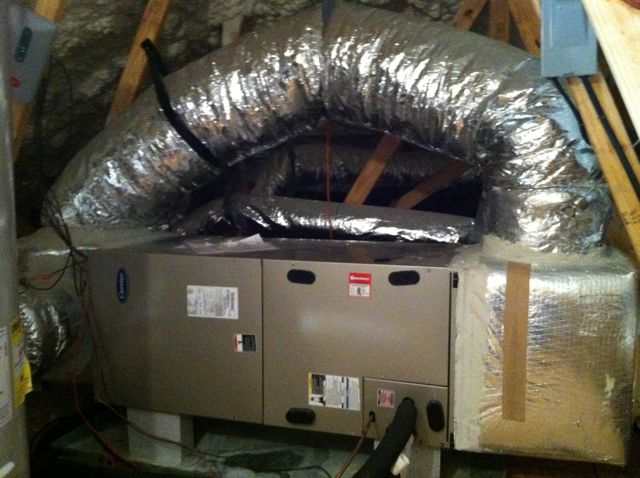
![Condensation On An Attic Air Handler [Photo By Energy Vanguard]](https://www.energyvanguard.com/wp-content/uploads/2026/09/attic-air-handler-condensation-drain-pan-water.jpeg)
I was talking to one of my sisters who lives in Florida, and she told me about someone she knows who was having trouble with her air conditioner shutting down. Naturally, that person called an HVAC company to come diagnose and fix the problem. The technician went into the attic and found the drain pan beneath the air handler had filled with water, which tripped the float switch that turns off the AC. So what did the tech say? He told her that this was just a normal thing that happens in Florida, and that she’d have to have the drain pan emptied every couple of months. But is a drain pan so full it shuts off the AC really a normal maintenance issue?
Why did water fill the drain pan?
An air conditioner’s evaporator coil in the air handler does two things: It cools the air passing over it (sensible cooling), and it removes water vapor from the air passing over it (latent cooling, aka dehumidification). In a hot, humid climate like Florida, both of these jobs are important.
Before continuing, I need to clarify something. An air conditioner actually has two drain pans. The primary drain pan is inside the air handler beneath the coil. The secondary drain pan is the one you see beneath the air handler.
The first reason for water in the drain pan—and the most common—is a clogged condensate drain. When that happens, the primary drain pan fills first and drains into the secondary drain pan. In Florida, the clog often is caused by bacterial biofilms. The biofilm can grow to fill the pipe, and technicians sometimes pull out long cylindrical plugs of it.
Condensate lines are really important, but today I want to focus on a different source of water. I’ll cover condensate issues in future articles (as suggested by frequent commenter RoyC).
The second reason is one I’ve been hearing about from various parts of Florida. It’s probably happening in many other hot, humid climates as well. This time, however, it’s from an unintentional source of condensation. I’m talking about condensation that forms on the outside of the air handler. Let’s see why this happens and what you can do about it.
How does condensation happen?
The cause is simple, really. When humid air gets near a surface that’s cold enough, more water vapor molecules start sticking to it rather than bouncing off. Once enough water vapor molecules stick, you start seeing beads of condensation on the surface. Like the droplets in the photo above.
The trigger for this transformation is that the surface temperature is lower than the dew point temperature of the air. On a sticky day in Florida, the dew point might be 77 °F (25 °C). Air conditioners help to keep people comfortable by making cold air. In a typical AC, that air is ~55 °F (13 °C).
All the attic air needs to start turning water vapor into liquid water is a surface that’s at a temperature of 77 °F or below. And hey, we’re moving 55 °F air through the air handler and ductwork. Is it possible to keep the exterior of the attic air handler above 77 °F with air that cold moving through it?
Why don’t all attic air handlers sweat?
Air conditioner manufacturers do provide insulation for their air handlers. That definitely helps keep the outside of the air handler above the dew point temperature. But in a hot attic, you have a couple of other things that help, too.
First, in a standard vented attic, the air temperature can get up to 130 °F (54 °C) or so. That certainly warms up surfaces.
Second, heat radiating down into the attic from the underside of the roof keeps the air handler warmer. Any materials that can see the roof deck receive that heat and warm up.
Those things save many air handlers from sweating in humid weather. Yes, you may occasionally see some condensation on the air handler, but it typically appears at thermal bridges and places where cold air leaks out. This usually isn’t enough to trip the float switch in the drain pan, though.
Two reasons attic air handlers sweat
Remember, condensation appears on a surface when its temperature is lower than the dew point temperature. Based on what I wrote above, you now may be able to figure out how that can happen. Air handlers may sweat a little in typical installations, as mentioned above. But here are two things that lead to atypical results:
1. A cooler attic. Regular vented attics get really hot. But there’s an energy efficiency improvement a lot of builders are using these days that makes them cooler.
I’m talking about radiant barriers. And it’s not just the lower air temperature that’s at work here. Yes, the cooler attic air keeps the air handler cooler. But it’s most likely the reduction in radiant heat flow from the roof deck directly to the air handler that cools the air handler the most.
2. Colder conditioned air. Most air conditioners produce air at ~55 °F. But there are ways to make that air colder. One way is to have a restrictive duct system. That reduces air flow, which reduces the coil temperature, which reduces the temperature of the conditioned air.
Another way is to have a fixed-capacity air conditioner with two or more zones and a bypass duct. When not all zones call for air conditioning, the excess air goes into the bypass duct. The bypass duct in turn dumps that already cold air back into the return side of the AC. Putting colder air into the system results in even colder air coming out. Sometimes it’s even enough to freeze the coil into a solid block of ice.
So, if you want to decrease the odds of condensation on the attic air handler, don’t do a zoned system with a bypass duct in an attic with a radiant barrier.
Potential fixes
Here are some things that can eliminate the condensation:
Encapsulate the attic. By moving the insulation and air barrier to the roofline, the attic will be inside the thermal enclosure. You still need to make sure to condition the air some way to keep the humidity down.
Eliminate the bypass duct. Read my article on zoning best practices for more details. I’m not a fan of bypass ducts, and most of our HVAC designs at Energy Vanguard zone with equipment, not dampers.
Replace dirty filters. A dirty filter by itself can cut the air flow a lot. I’ve seen cases where it even led to freezing the coil.
Fix the duct system. If the problem is low air flow, find out why it’s low. Duct systems get screwed up in many ways, so find someone who understands air flow to make it right.
Adjust the refrigerant charge if necessary. When the system is low on refrigerant, the coil and suction line (the insulated copper pipe) can get colder. That’s probably not enough to trip the float switch, but it might contribute.
Move the air handler into conditioned space. Even if you keep the ducts in the vented attic, getting the air handler into conditioned space can make a big difference.
Some of these fixes are easy (change the filter), and some are difficult and expensive. But you should never consider emptying the drain pan under an attic air handler as a regular maintenance item. If any HVAC company tells you it is, send them packing.
Allison A. Bailes III, PhD is a speaker, writer, building science consultant, and the founder of Energy Vanguard in Decatur, Georgia. He has a doctorate in physics and is the author of a bestselling book on building science. He also writes the Energy Vanguard Blog. For more updates, you can follow Allison on LinkedIn and subscribe to Energy Vanguard’s weekly newsletter and YouTube channel.
Related Articles
3 Important Facts About Dew Point Temperature
To Zone or Not to Zone…and How?
Oooh, Shiny Stuff! – Radiant Barrier Fundamentals
How to Clean Out Your Air Conditioner’s Condensate Line
Comments are welcome and moderated. Your comment will appear below after approval. To control spam, we close comments after one year.
As always a great article. I learned about condensate drain lines when we discovered that the original installer zip tied the drain line (tightly) to the line set. Once the drain pan filled (thankfully) the overflow alarm shut the unit off and we discovered the problem. What’s your opinion on plumbing (where possible) an overflow line that let the water drain out of the overflow pan? Ours is still on the to do list.
Butch: That shouldn’t have been a problem with your 2 ton split system because the condensate line should have been rigid pipe (usually PVC). Are you saying they used flexible vinyl tubing instead? If so, it should be replaced with rigid pipe. I’ll cover more condensate line best practices in my upcoming articles.
Regarding a drain pan overflow, both drain pans should have that. The primary drain pan in the air handler should have either a pipe to the secondary drain pan or a float switch that turns the AC off.
I’ve lived in my Florida home since 1985 and only had the condensate pan in the attic fill up once – due to clogged drain. Here is what I do:
Vacuum out the condensate drains every spring
I also use a smoke pencil to find all the leaks in the air handler (they always have them), and seal them with foil tape (NOT duct tape!) or mastic.
Change my filters regularly, and prevent bypass by putting blue painter’s tape around them – a trick I learned from this site.
No condensation on the outside of my air handler – and I have radiant barrier.
Sounds like you’re doing everything right, John. Keeping dirt out of the air stream keeps the coil and the condensate cleaner. That reduces the amount of nutrients the slime bacteria need to grow.
Building code should require all HVAC equipment and duct to be inside the house envelope. Anything in the attic is a loss and waste of energy. We have 3 builders who now design their homes with the HVAC inside the home. This lowers the bid typically by 1/2 a ton of cooling, lowers cost of the duct that does not have to be insulated and makes the service technicians much happier when it comes time to service the HVAC.
Hear! Hear! Yes, putting air handlers and ductwork in unconditioned space of any kind is a bad idea.
Greg… so when you say ” hvac inside the home”, are you referring to just the AH or ducts in conditioned soffits?
Hi Allison,
2 of the 3 resolutions arent just that simple.
Encapsulated attics here in FL are turning up with moldy ducts.
AH in conditioned space, are still condensating and creating mold on the fiberglass plenum penetrating the ceiling.
Please let me know potential reasons why!
Tina: A common problem with encapsulated attics is that a lot of builders and others who do this work spray the foam and then walk away. First, they need to be inspected and tested for airtightness. Many spray foam attics have significant air leakage. Second, they need to be conditioned to control humidity. Here’s one of my most recent articles on this:
Can an Exhaust Fan Control Humidity in a Spray Foam Attic?
https://www.energyvanguard.com/blog/can-an-exhaust-fan-control-humidity-in-a-spray-foam-attic/
A plenum going from conditioned space into a vented attic can allow humid air into the house or mechanical room. It’s easy to mess that up…and many do.
I’ve wrapped adhesive IXPE Closed Cell Insulation Foam (foil faced) on my air handler in the roof space.
This was on sections that had little to no insulation on them.
How much of a difference it has made I can’t tell as I did this as soon as the installers left and I realised the problem. The outside of the air handler doesn’t feel cold in summer any more, or hot in winter.
Dale: I’ve seen that done with rigid foam insulation here in the States, too, but it didn’t work so well. In that case, it wasn’t sealed so attic air got in behind the insulation and condensed.
Some spray foams don’t work well with vibrations and can become detached, but air handlers typically don’t vibrate heavily so that may not be the reason for the failure.
From what I read online the quality of adhesion seems to depend on the quality of surface preparation – oil free, clean but also abraded with sandpaper to allow the foam to key into the metal.
Closed cell insulation with an adhesive backing looks more forgiving.
Also I cover over all the insulation edges with aluminium tape which should prevent moisture ingress – not that I think it really needs it – the adhesive is immensely strong, but I don’t know how it will hold up over the long term.
When I was more active in HVAC contracting, I advocated for non-metallic air handlers – the TAM series line shared by Trane and American Standard. They have foam insulation encapsulated between inner and outer plastic walls rather than fiberglass held by scrim tape that always seems to mildew, tear, etc.
One of the other advantages of the Trane air handler is that it is a “blow-through” design where the blower is upstream of the coil and the coil is V-shaped rather A-shaped. This results in most of the cabinet interior being exposed to the return air temperature rather than the coil discharge temperature. This reduces the potential for sweating as well as reducing heat loss or gain when used in unconditioned spaces. As far as I know, this is the only available air handler that does not use a draw-through A-coil design.