
Infiltration Is NOT Ventilation
Over the past few decades, we’ve made great strides in reducing infiltration in homes. But we know that achieving greater airtightness requires paying more attention to indoor air quality. One of the primary ways we improve IAQ in airtight homes is with ventilation. (See this article for other methods.) We do have more work to do, though, because I still hear people say, “A house needs to breathe.” Those folks think infiltration helps, so today let’s look at why it’s not equivalent—or even close—to ventilation.
There’s a saying for this: Build tight; ventilate right.
The definitions
Infiltration is uncontrolled inward airflow through random leaks in the building enclosure. But for air to flow through those leaks, there needs to be a pressure difference across the hole. (See rule number three here.) Trouble is, pressures vary, and the locations and sizes of the holes are random. That means the amount of infiltration can vary wildly.
Ventilation is the intentional exchange of indoor air with outdoor air to dilute the indoor air pollutants with cleaner outdoor air. The word “intentional” there is key. When the outdoor air is filled with particulates and toxic gases from wildfires or other sources, you can turn the ventilation system down or off. With ventilation, you also can control the rate—hour-by-hour if you like—the timing, the source, and where you direct the air. (How much control you actually have, though, depends on the type of ventilation system.)
The basic choice, then, is random versus intentional.
How infiltration fails
Let’s look at the main reasons infiltration isn’t as good as ventilation.
The rate varies with weather. OK, you’ve got your house with all those random holes in the building enclosure. How much air moves through a hole, though, depends on the pressure difference across the hole. Two of the three ways that pressure differences arise—stack effect and wind—depend strongly on weather. On calm days with mild temperatures, you won’t get a lot of infiltration. On cold, windy days, you’ll get more air changes than you need. The third driver of pressure differences is mechanical systems, like exhaust fans and duct leakage.
Infiltration location varies. Where the air leaks in depends on where the holes are and what’s happening with the pressure differences. Stack effect, for example, causes air to infiltrate at the bottom of the house and exfiltrate (leak out) at the top on cold days. The upper-story bedrooms may not be benefiting much from the air leaking in. Likewise, wind will push air into the house on one side and suck it out on the other.
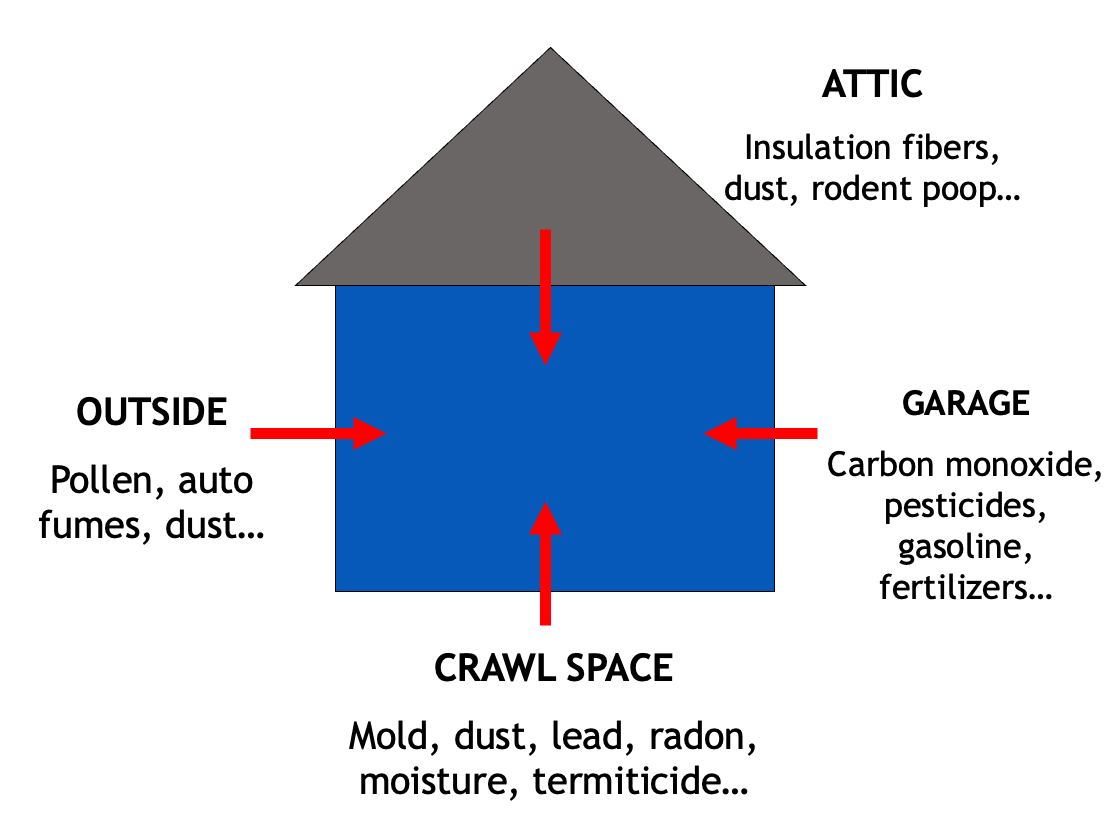
Infiltrating air may be worse than indoor air. When air leaks in from a garage, attic, or crawl space, you’re almost certainly not getting clean air. Even the air leaking in straight from the outdoors, though, can bring in pollutants that a mechanical ventilation system could filter out.
You can’t turn it on, off, up, or down. Got extra people in the house? Burned the grilled cheese in the kitchen? Close the bedroom doors at night? There’s no adjustment for infiltration.
Infiltration costs you more for heating and cooling. On those cold days when the wind is blowing too much air through your leaky building enclosure, you’re going to pay more for heating. On hot, sticky summer days, you’re going to pay extra for cooling.
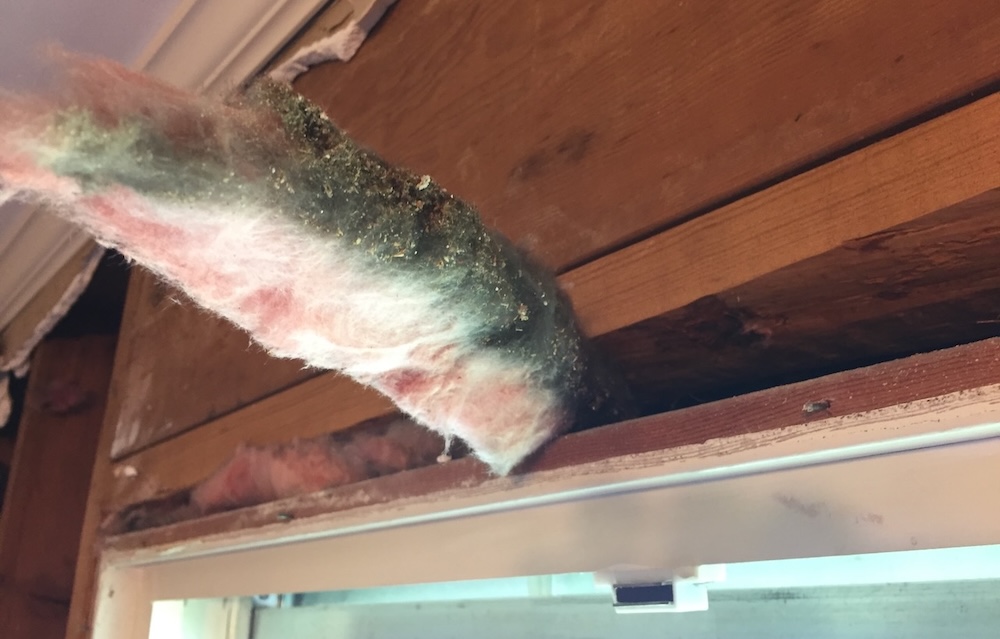
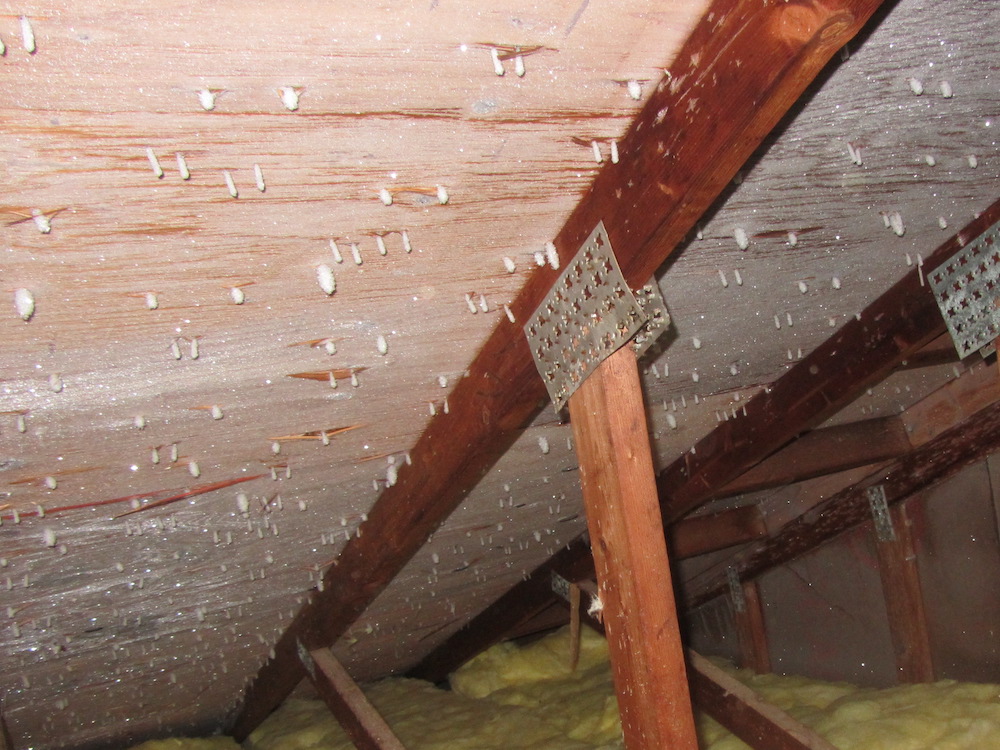
Infiltration can cause moisture problems. Infiltration is accompanied by exfiltration, and indoor air leaking out in winter carries moisture with it. That moisture can wet the cold sheathing and framing it finds inside building assemblies or form frost in the attic (photo below). In a humid climate, humid air leaking into the house in summer can create the ideal conditions for mold growth.
Atlanta infiltration vs. ventilation
Using weather data from 2025, I had Claude make the chart below using Open-Meteo ERA5 weather data. It shows modeled infiltration in a 2,400 square foot, two-story house in Atlanta. The house is fairly leaky, with a blower door test result of 10 air changes per hour at 50 pascals (ACH50). The hourly infiltration graph (blue) comes from the Sherman-Grimsrud infiltration model and shows how infiltration varies over the course of a year. The orange graph is outdoor temperature, and the green shows wind speed at 10 meters above the ground. The horizontal dashed line in the first graph is the rate for this house calculated from the residential ventilation standard (ASHRAE 62.2).
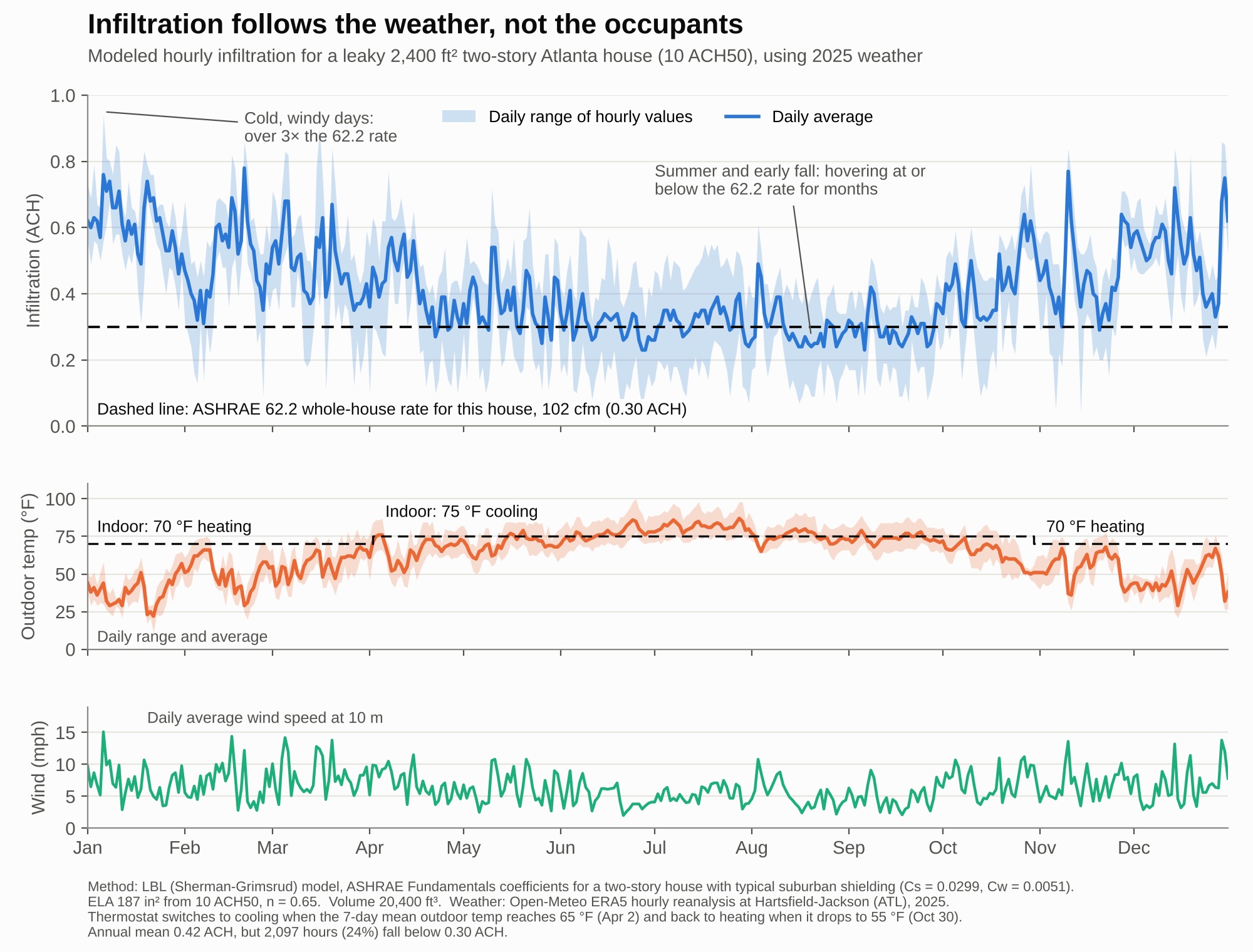
Notice that there are a lot of hours below the 62.2 rate. In this case, the infiltration is below the 62.2 rate for 2,097 hours, or 24 percent of the year. During those times, the house may not be getting enough air changes. In contrast, the winter infiltration rate can be as much as three times the 62.2 rate. (There’s definitely been a lot of debate about what the correct ventilation rate is, but the ASHRAE 62.2 standard is what we have. And the ventilation rate required by the building code is about the same.)
But we’re talking about infiltration here. You can’t turn it up or down. You get what you get…and it’s often the wrong amount.
Many airtight new homes lack air exchange
The model building code for new homes (International Residential Code, or IRC) makes it clear. When you reach a certain level of airtightness, the house requires mechanical ventilation. That threshold is 5 air changes per hour at 50 pascals (ACH50). And since 2021, the IRC requires that level of airtightness for all new homes.
Now, here’s the problem. Some states or local jurisdictions have overridden that requirement. Here in Georgia, for example, home builders have to achieve an airtightness 5 ACH50 or less, but they don’t have to put in ventilation unless the airtightness is 3 ACH50 or less.
Big mistake, in my opinion. The chart below shows why.
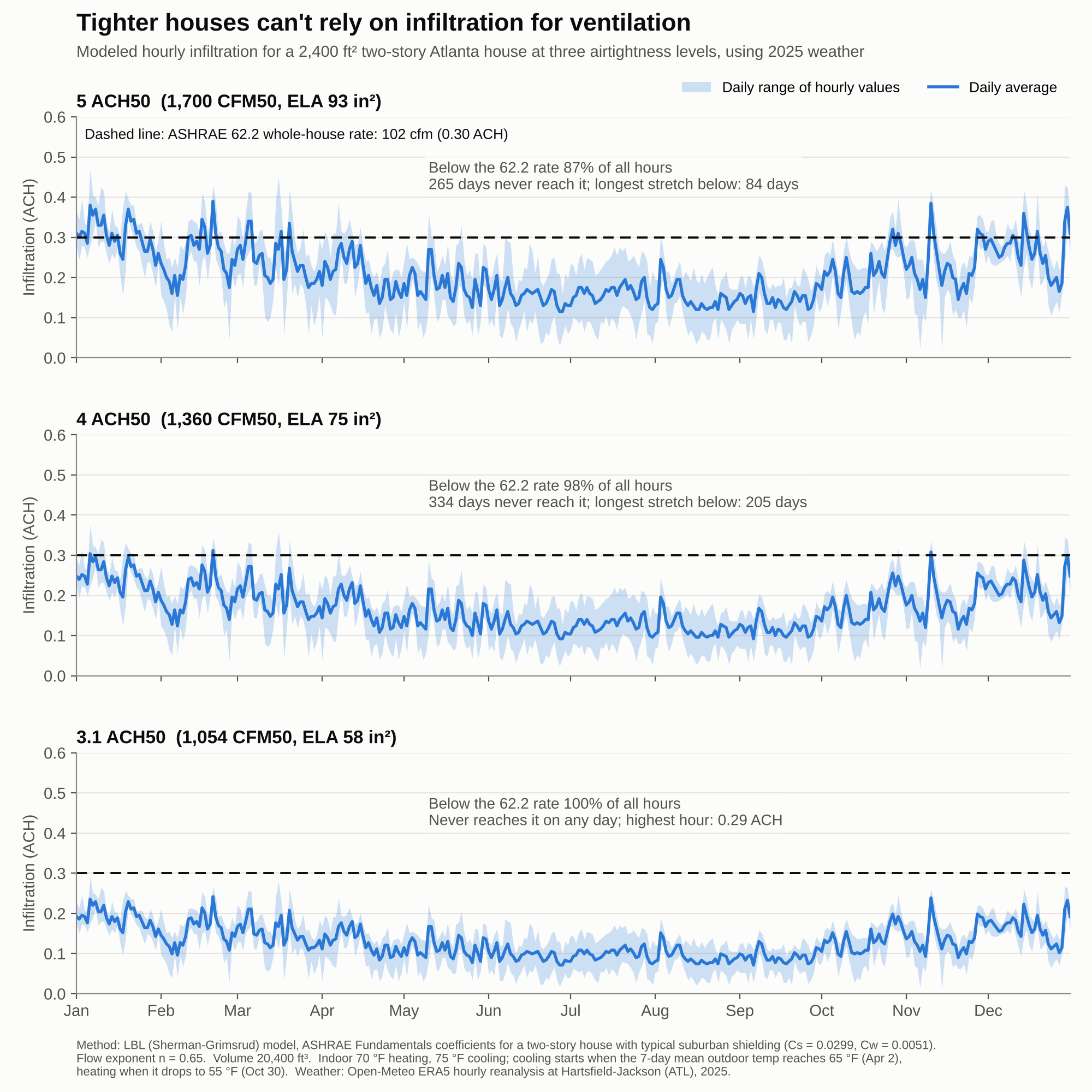
What you see above is the modeled infiltration rate over the course of a year for houses that meet the airtightness requirement at 5 ACH50, 4 ACH50, and 3.1 ACH50. The top graph shows infiltration exceeding the 62.2 rate a little bit in the winter. But it’s below the 62.2 rate for 87 percent of the hours in a year. And by the time you get down to 3.1 ACH50, the infiltration rate is below the 62.2 rate for 100 percent of the hours in a year.
This is a serious liability for builders who hit those airtightness levels yet omit the mechanical ventilation. In Georgia, for example, a house that passes the blower door test is rarely going to meet the 62.2 ventilation rate with infiltration alone.
Can old leaky houses benefit from ventilation?
On the opposite end of the airtightness spectrum, does it make any sense to put whole-house mechanical ventilation into an old leaky house? Some people say it’s like adding a spoonful of wine to a barrel of sewage. You still have sewage. But go back and reread the above sections on how infiltration fails and look at the infiltration graph for the 10 ACH50 house.
Even in a leaky house, you still have the problem of inadequate air exchange in bedrooms with closed doors. You’re also still likely to have plenty of hours with infiltration not bringing in enough outdoor air.
So, yeah. Whole-house ventilation in a leaky house can help increase air changes on the low infiltration days as well as put the outdoor air where you need it.
Ventilation is a choice. Infiltration isn’t.
Both infiltration and ventilation move air across the building enclosure. If you don’t mind having too much or too little air exchange, don’t care where the air goes to or comes from, or just love to breathe dead possum, infiltration can do that for you. But if you want a healthy home, go with ventilation (and the other methods I’ve discussed).
Allison A. Bailes III, PhD is a speaker, writer, building science consultant, and the founder of Energy Vanguard in Decatur, Georgia. He has a doctorate in physics and is the author of a bestselling book on building science. He also writes the Energy Vanguard Blog. For more updates, you can follow Allison on LinkedIn and subscribe to Energy Vanguard’s weekly newsletter and YouTube channel.
Related Articles
7 Steps to Good Indoor Air Quality
How Airtight Can You Make an Older House?
11 Ways to Screw Up an ERV Installation
Are You Breathing Dead Possum? — Crawl Spaces, HVAC, & IAQ
Infiltration Occurs at the Surface, Not in the Volume
Comments are welcome and moderated. Your comment will appear below after approval. To control spam, we close comments after one year.
Allison, another great topic, another great article.
Here is a huge obstacle. In my experience with homeowners, the average knowledge of what ventilation is, or let alone infiltration, is below rudimentary, including notions such as “AC provides fresh air”.
We need ridiculous amounts of public messaging to educate. Starting in elementary school, but also in every Realtor or GC mandatory CE class. Maybe even as a mandatory brochure at every home closing, and every loan refinance (doubt there are a lot of those happening these days). Maybe HD and Lowe’s can hand them out with every HVAC filter sold.
I love the graphs. Especially the Atlanta temperature graph since one of my leaky houses is in Atlanta. Regarding “But we’re talking about infiltration here. You can’t turn it up or down.” You can always open windows and/or doors. And I do. I agree that the building codes that require “Build tight and ventilate” are well intentioned. However, since we have major problems with affordability perhaps builders trying to build affordable homes should be able to do some things the old fashioned way. If you do an analysis of energy cost savings for the extra construction expense. Be sure to include the cost of maintaining the ventilator, it’s filters, and especially the ductless heat pumps.
As a long-time homeowner (not an HVAC pro), I didn’t realize I needed to manually ventilate my house until fairly recently, especially as it’s counterintuitive to running the heater or AC, and I wouldn’t rely on any of my neighbors being particularly educated on this either. I consider doors and windows an attempt at passive ventilation, not infiltration (I fitted an HVAC filter into one of my windows). Given the choice, I would have happily redirected some of the construction cost from my oversized AC equipment toward a ventilation system, even a basic one.
if the electricity were to go out in early fall, you’d still be back to the same problem. If all windows are left open, would an airtight house become just like a leaky house? I’m inclined to say, not unless the windows actually allow good airflow throughout the house.
Great observations. It is interesting that there was a time that we did a better job with passive ventilation.
Take a look at The Boyle System of Ventilation from 1895. https://dn790002.ca.archive.org/0/items/cu31924015343738/cu31924015343738.pdf
I want to offer something that will probably be considered controversial. But I think my postulate is or will become a settled matter in mixed humid climates.
We should not talk about whole house ventilation without full disclosure that it MUST be accompanied by a whole house dehumidifier or some alternative to handle the additional moisture load in the ventilation air with dew points >65-70°F. This has become a major issue that few are willing to mention.